Successful IoT lighting system integration is not only about connecting lamps to an app. It requires a complete structure where lighting hardware, wireless modules, firmware, cloud service, mobile control, user permissions, and scene logic work together. When these parts are planned separately, the system may face pairing failure, command delay, unstable group control, or high maintenance cost after launch.
Surplife provides Smart Lighting products with app customization, IoT platform compatibility, RGBIC lighting effect algorithms, multi-device sync, OEM/ODM capability, and supply chain support. Its product ecosystem covers smart lighting, Decorative Lighting, Permanent Lighting, LED Flexible Screen, engineering lighting, electrical accessories, and scene lighting, which makes platform integration a core part of product development.
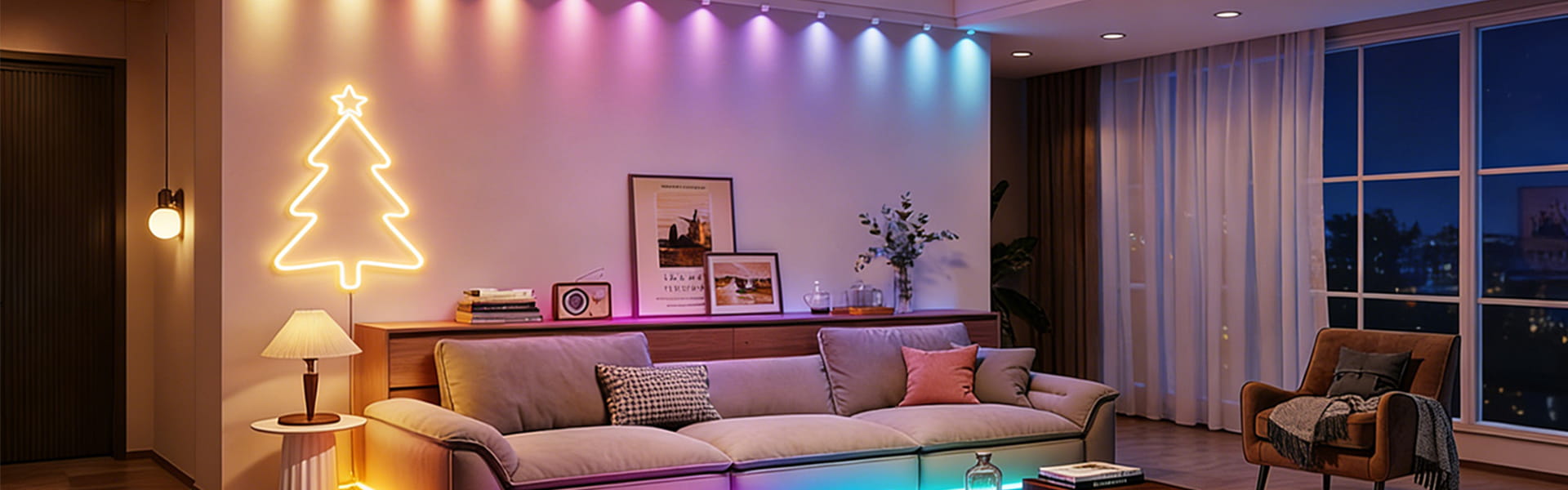
A lighting project should not start by asking only which app to use. The first step is to define what the platform needs to control. A home lighting product may need simple pairing, voice control, timer settings, and scene presets. A commercial project may need zoning, account roles, remote monitoring, and multi-device management. A decorative lighting system may require dynamic color effects, music sync, RGBIC control, and synchronized scene changes.
This early planning helps avoid unnecessary software functions. It also keeps the product easier to test before mass production.
Stable smart lighting platform connection depends on the right communication method. WiFi is suitable for remote control and cloud connection. Bluetooth can support fast discovery and local setup. Mesh structures can help multiple lights communicate more smoothly across larger spaces.
Surplife’s IoT platform compatibility information describes a WiFi dual-mode structure using 2.4G WiFi and BLE. BLE is used for device discovery and one-click network configuration, while WiFi handles data transmission between lights, the local network, and the cloud platform. This structure supports local and remote control, making it useful for smart light strips, smart luminaires, home lighting, and lighting systems that require cloud access.
A good lighting device connectivity solution should define how commands move through the system. When a user taps the app, the command may travel from the phone to the cloud, then to the router, then to the lighting device. In some local scenes, the command can be sent directly through WiFi or Bluetooth.
The system should answer these questions before development:
How does the device enter pairing mode?
What happens when the router restarts?
Can basic control still work locally?
How does the app show online and offline status?
How are firmware updates delivered?
How are grouped lights synchronized?
Clear logic reduces unstable behavior and makes troubleshooting easier for installers, operators, and after-sales teams.
To integrate smart lighting with IoT platforms, the app must match the actual lighting hardware. If the lamp supports only basic dimming, the platform should not show complex effect controls. If the product supports RGBIC, music sync, multi-device grouping, and scene automation, the app interface should make these functions easy to find and easy to operate.
The Surplife app allows users to control WiFi lighting products, personalize lighting with 16 million colors, group smart lights, set timers, sync bulbs to music, and control lights remotely. Its Google Play listing was updated on April 30, 2026, which also shows the need for continuous app maintenance after product launch.
Testing should cover more than whether the lamp turns on. IoT lighting must be tested as a full system, because the real user experience depends on connection, response speed, scene execution, and recovery after network changes.
| Testing Area | What To Check | Why It Matters |
|---|---|---|
| Pairing process | First connection success rate | Reduces setup failure |
| Network recovery | Response after router restart | Improves daily reliability |
| Group control | Multiple lights changing together | Supports project scenes |
| Cloud response | Remote command speed | Improves app experience |
| Firmware update | OTA upgrade stability | Prevents version conflict |
| Scene execution | Timer, color, and mode accuracy | Keeps lighting behavior consistent |
A standardized test process can reduce hidden problems before shipment and make OEM/ODM delivery more predictable.
A smart lighting product may begin with one app, but future market needs may include voice assistants, project dashboards, third-party ecosystems, cloud management, or data-based product improvement. For this reason, the platform should be scalable from the start.
Surplife presents the smart lighting app as part of a complete architecture that includes AI smart control, Matter connection, cloud platform integration, AIoT customization, RGBIC algorithm support, multi-device sync, and OEM/ODM development. This approach helps lighting products move from single-device control to a wider connected lighting ecosystem.
This smart lighting IoT system integration guide shows that successful integration depends on early planning, stable connectivity, clear device-to-cloud logic, hardware-matched app functions, complete testing, and scalable platform design. Surplife’s advantage is its ability to combine smart lighting hardware, app customization, IoT compatibility, RGBIC lighting algorithms, multi-device synchronization, and OEM/ODM support into one coordinated solution. For lighting products that need long-term competitiveness, IoT integration should be designed as a full system from the beginning, not added as an extra function after the product is finished.