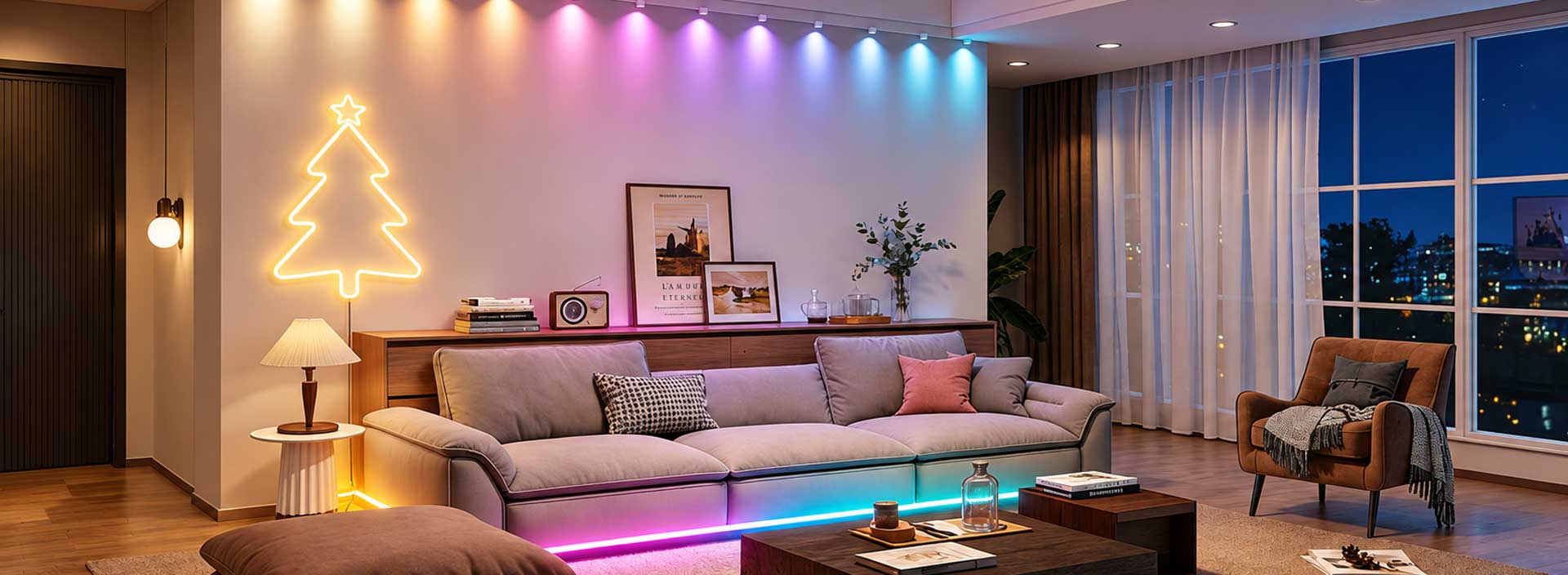
Pixel Mapping via Photo-based Positioning is a LED mapping technology based on 3D spatial positioning. By precisely modeling the position of each individual LED pixel in real space, it achieves a high degree of consistency between lighting effects and physical layout. The process involves using a camera to capture the positions of the LEDs and applying corresponding mapping algorithms to accurately determine the spatial coordinates of each pixel, enabling precise control.
This technology, based on images captured by a camera, utilizes image processing techniques and algorithmic mapping to automatically locate each LED pixel, facilitating accurate control within intelligent lighting systems.
During the configuration process, the system uses a mobile device's camera to scan and capture the luminaire. Combining image recognition and spatial reconstruction algorithms, it automatically identifies and records the three-dimensional coordinate information of each LED. This eliminates the need for manual point-by-point calibration, significantly reducing deployment and maintenance costs.
After Mapping is completed, all LED pixels are uniformly mapped into a virtual 3D coordinate system. The lighting control system performs effect calculations based on this coordinate system, ensuring that effects like text, graphics, and dynamic patterns are displayed accurately according to the actual spatial form, regardless of light string length, wiring path, or installation shape.
This technology is primarily used in dynamic lighting effects, light-controlled art installations, stage lighting, and other fields. It allows for real-time adjustment of each LED's brightness, color, and effects based on the captured images.
Spatial modeling of luminaires of arbitrary shapes (e.g., tree-shaped, facade, custom structures)
Unified lighting effect programming across devices and light strings
Dynamic animations and text display based on spatial coordinates
Rapid remapping after luminaire reinstallation, enhancing system flexibility
Image Capture & Positioning: Uses high-resolution cameras to capture the distribution of LED pixels, identifying the coordinate position of each.
Spatial Mapping: Employs image processing algorithms to map each LED's position into a 3D coordinate system, achieving accurate spatial positioning.
Real-time Dynamic Adjustment: Adjusts LED attributes like color and brightness in real-time based on user or control system demands, supporting complex lighting variations.
Multi-pixel Collaborative Control: Enables multiple LEDs to work synchronously or independently through precise positioning information, creating richer lighting effects.
Environmental Adaptability: Adapts to different shooting angles and lighting conditions to ensure accurate identification and positioning even in complex environments.
Precise Positioning & Control: Enables efficient lighting effect control and creation with greater operational flexibility through accurate pixel positioning.
No Manual Intervention Needed: Reduces tedious manual adjustments; automated system enables efficient control, saving time and labor costs.
High Adaptability: Adapts to complex environments, such as large-scale lighting layouts or varying camera angles, achieving systematic management and control.
Enhanced User Experience: Provides richer and more personalized lighting experiences through precise lighting adjustment and synchronized control, improving environmental ambiance.
Flexible Integration: Can be seamlessly integrated with existing systems like smart homes or stage control systems, enhancing their functionality and performance.
Camera Capture & Image Processing: Uses high-resolution cameras to capture LED distribution images. Image processing algorithms analyze these images to extract the positional information of each LED.
Position Mapping Algorithm: Converts the 2D image data of each LED's coordinates into its actual position in 3D space using mapping algorithms.
LED Control System: The central control system manages parameters like brightness, color, and mode for each LED based on the obtained positional information, precisely achieving preset effects.
The core advantage of Pixel Mapping via Photo-based Positioning lies in its ability to combine modern computer vision with intelligent lighting control technology. This enables precise control and orchestration of LED pixels in complex environments, offering more flexible and accurate solutions for smart lighting, stage effects, advertising displays, and other scenarios.