Smart Lighting control is moving from simple remote operation to a more connected, intelligent, and scenario-based system. Buyers no longer look only at whether a lamp can be turned on by an app. They care more about whether the whole system can support stable connection, flexible scene control, device expansion, cloud management, and long-term product upgrades.
This is why smart lighting control system trends are becoming closely connected with IoT platforms, app experience, multi-device synchronization, and data-driven control logic. For lighting product development, the future is not only brighter hardware. It is a complete control ecosystem that makes lighting easier to manage across homes, stores, hotels, outdoor areas, and commercial spaces.
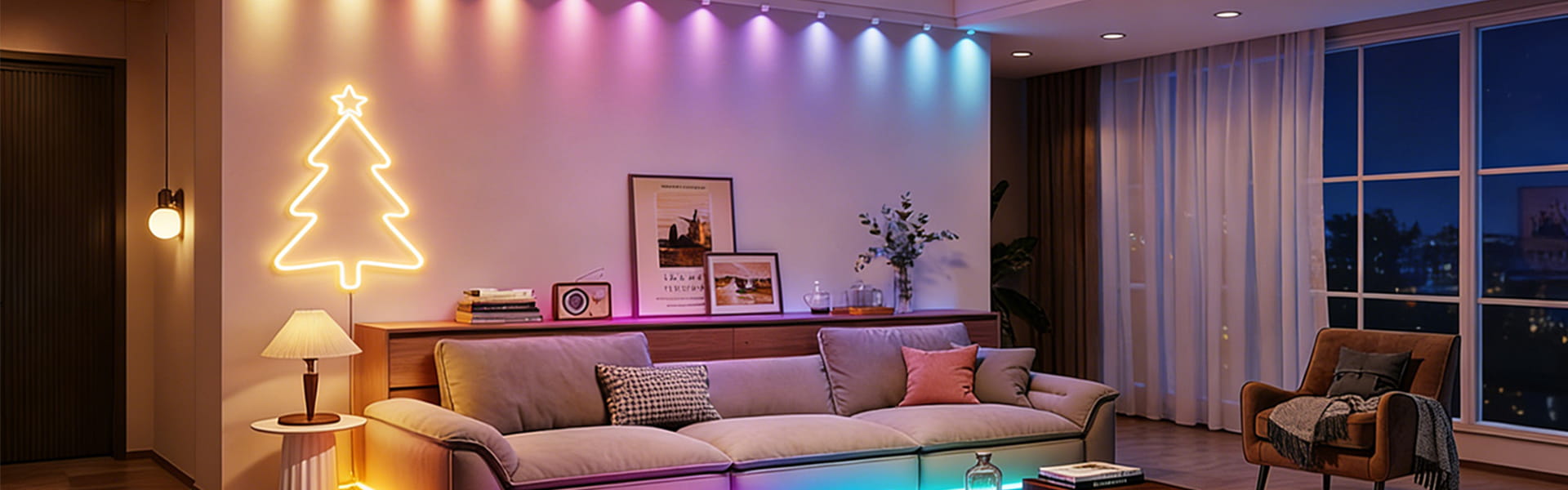
Early smart lighting products mainly focused on one lamp, one remote, or one mobile phone connection. The next stage is whole-scene management. A lighting system may need to control ceiling lights, floor lamps, light strips, wall lights, garden lights, and Decorative Lighting through one unified platform.
This change makes scene logic more important. Users may need a reading mode, movie mode, sleep mode, party mode, display mode, or outdoor landscape mode. Each scene requires different brightness, color temperature, RGB effects, timing, and device grouping.
For manufacturers, this means product planning should not treat each lamp as an isolated item. The control system should be able to add new devices, manage different rooms, and keep operation consistent across product categories.
Future control systems will depend more on IoT platforms. The platform connects lighting hardware, app control, cloud service, firmware updates, user permissions, and data feedback. Without this central layer, it is difficult to manage large numbers of devices or support long-term system upgrades.
Strong IoT lighting technology development allows smart lighting products to move beyond basic switching and dimming. It supports remote control, scheduling, device sharing, group control, cloud synchronization, automation, and later feature updates.
A practical platform should be stable, scalable, and easy to integrate with different lighting products. It should also support firmware version control, device status monitoring, and connection recovery after network interruption.
| Development Direction | Practical Value |
|---|---|
| Multi-device synchronization | Keeps lighting effects consistent across many lamps |
| App customization | Supports brand identity and different market needs |
| Cloud management | Enables remote access and centralized control |
| Firmware upgrade | Extends product life after shipment |
| Scene automation | Improves user experience in daily lighting scenarios |
| Dual-mode connection | Helps improve pairing and control flexibility |
The intelligent lighting solutions market will continue to favor systems that are easy to install, easy to control, and easy to expand. Products with beautiful light effects but weak control logic may face more after-sales issues, especially when used in larger spaces or multi-product environments.
More functions also mean more connection pressure. When a system includes app control, WiFi connection, Bluetooth pairing, cloud service, scene switching, and device grouping, connection reliability becomes a key factor.
Future systems should reduce pairing failures, delayed response, offline status, and inconsistent device feedback. Dual-mode WiFi and Bluetooth designs can help improve network setup and daily operation. For large-space or multi-device use, synchronization speed and signal coverage should also be tested carefully.
A stable control system should recover smoothly after power interruption, router changes, app restart, or temporary network problems. These small details have a direct influence on customer satisfaction and product reputation.
The app is the visible control center of smart lighting. Future app design will focus more on clarity, speed, and practical control paths. Users should be able to find power control, brightness adjustment, color selection, timer settings, and scene modes without confusion.
For customized lighting products, app flexibility is also important. Different markets may require different languages, icons, control pages, product names, and scene settings. A professional system should allow enough customization while keeping the core control logic stable.
This is where future smart lighting control systems will become more competitive. The best solutions will combine clean interface design with strong background technology, so users feel that the product is simple while the system remains powerful.
The future of lighting control cannot rely only on software. Hardware stability is still the foundation. Controllers, LED drivers, power design, antenna layout, waterproof structure, and thermal control all affect final system performance.
Software can improve operation, but poor hardware can still cause flickering, delay, overheating, or unstable response. For this reason, smart lighting development should connect hardware design, firmware logic, app functions, and production testing from the beginning.
Before mass production, products should be tested for long-hour operation, repeated switching, dimming consistency, color effect performance, device grouping, app reconnection, and packaging protection.
The next generation lighting control technology will be more integrated, more flexible, and more suitable for scenario-based applications. It will not only control lights, but also connect devices, manage scenes, support customization, and help products remain useful after market launch.
Surplife focuses on smart lighting products and intelligent control solutions, covering app-controlled lighting, decorative lighting, Permanent Lighting, Engineering Lighting, scene lighting, and IoT-related platform support. With integrated hardware, software, app, and cloud management capability, smart lighting products can become easier to launch, easier to manage, and easier to expand across different application markets.
The future belongs to lighting systems that are stable, connected, upgradeable, and built around real user scenarios. A strong control system will turn smart lighting from a single product feature into a long-term product advantage.