
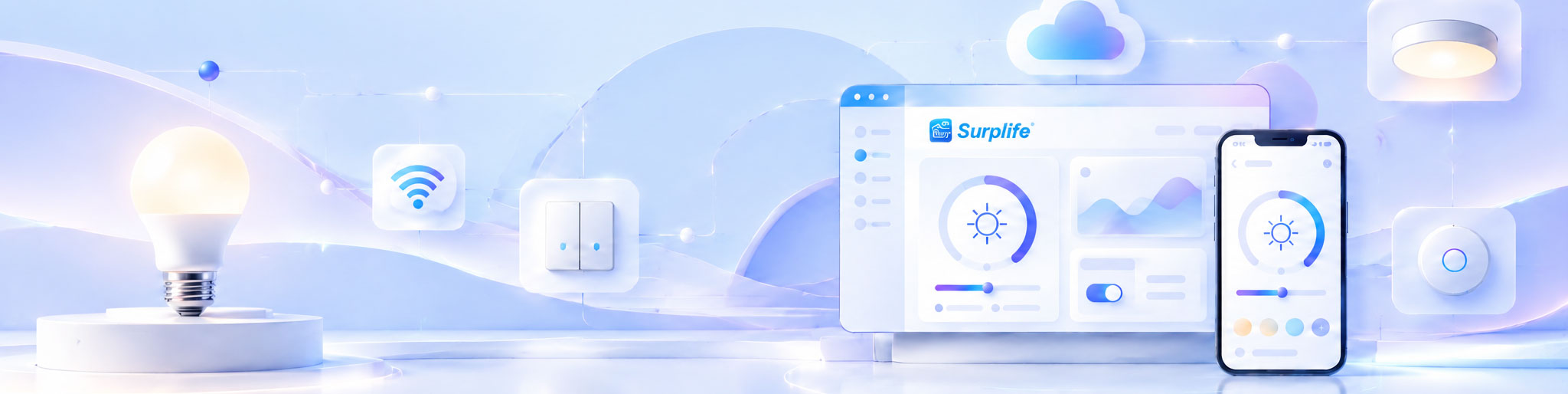
Selecting a lighting control architecture requires matching communication methods, controller capabilities, software platforms, and management requirements to the intended application. The right architecture depends on how many devices need to communicate, whether control must work locally or remotely, how automation is implemented, and whether the system will expand in the future. For manufacturers and project developers, making this decision early helps avoid unnecessary hardware changes, integration difficulties, and additional software development costs.
A lighting control architecture defines how lighting devices receive commands, exchange information, and respond to users or automated instructions. It determines the relationship between physical lighting products, controllers, communication networks, applications, and management platforms.
Two lighting products may offer identical functions on the surface but use completely different internal architectures.
For example, one product may receive commands directly from a smartphone through Bluetooth, while another connects to a wireless network and communicates through a cloud platform. Both may support brightness adjustment, but their remote access capabilities, connection dependencies, and maintenance requirements are different.
The architecture also affects product development costs. A system requiring multiple gateways, customized firmware, and cloud integration will generally involve different engineering resources from a standalone wireless controller.
Therefore, architecture selection should begin with the intended operating model rather than a preference for a particular communication technology.
There is no universal architecture suitable for every lighting application. Several common structures serve different product and project requirements.
In a standalone structure, a lighting device operates through its own controller without depending on a centralized management platform.
Control may be provided through physical switches, infrared remotes, or built-in control interfaces.
This arrangement is suitable for products with relatively simple operating requirements, such as basic Decorative Lighting or individual LED installations.
Its main advantage is simplicity. There are fewer communication dependencies and no requirement for a complex cloud management system.
However, centralized monitoring, remote access, and large-scale device coordination may be limited.
This structure connects lighting devices directly to nearby control equipment through technologies such as Bluetooth.
A smartphone can communicate with a compatible controller to adjust brightness, colors, and lighting effects.
It is commonly used in consumer Smart Lighting products where convenient local operation is more important than centralized management.
The main design consideration is communication coverage. If users need to control devices from distant locations, additional network infrastructure may be necessary.
A gateway-based system introduces an intermediate device that connects lighting products to a wider communication network.
Multiple lighting controllers can communicate with the gateway, which manages data exchange between the local devices and external platforms.
This structure is useful when a project involves multiple devices, different communication protocols, or centralized control requirements.
However, gateway capacity, device compatibility, and network recovery behavior should be evaluated before deployment.
A cloud-based architecture connects lighting products to an online management platform through an internet connection.
Users can access supported functions through mobile applications or web interfaces, even when they are away from the installation site.
This approach is suitable for remote lighting management, multi-location operations, centralized device monitoring, and software-based service expansion.
Its main dependency is network and cloud availability. Essential local functions should therefore be considered separately to prevent internet interruptions from affecting basic lighting operation.
The intended application is one of the strongest indicators of which control structure is appropriate.
A residential decorative lighting product may only require direct wireless control, customized scenes, and convenient mobile operation. Introducing a complex centralized management system could increase development costs without providing meaningful benefits.
Commercial installations have different requirements. A retail chain operating several stores may need centralized scheduling, remote configuration, device grouping, and different permission levels for headquarters and local employees.
For Engineering Lighting projects, the architecture may need to coordinate multiple lighting zones, environmental sensors, local control panels, and cloud-based monitoring.
The decision can be approached through three practical scenarios:
Individual Lighting Products: Prioritize simple connectivity, convenient operation, and reliable device-level control.
Connected Product Ecosystems: Prioritize device compatibility, shared applications, consistent firmware interfaces, and multi-device synchronization.
Commercial and Engineering Installations: Prioritize centralized management, hierarchical permissions, automation, remote monitoring, and local operation during network interruptions.
The important distinction is whether the product is expected to operate independently or become part of a larger connected environment.
Beyond application requirements, several technical conditions determine whether a proposed architecture can operate reliably.
Communication Coverage
Assess the physical distance between devices, installation obstacles, wireless interference, and the number of connected devices. A communication method that works well in a small room may not provide sufficient coverage across a commercial building.
Controller Processing Capacity
The controller must handle the expected number of commands, lighting channels, dynamic effects, and connected functions. Complex synchronization and automation may require greater processing resources.
Network Reliability
Evaluate what happens when a router, gateway, or internet connection becomes unavailable. The architecture should define which functions continue locally and which depend on external services.
Integration Requirements
Check whether the lighting system needs to connect with voice assistants, sensors, building management systems, or other IoT devices. Supported interfaces and actual interoperability should be verified rather than assumed.
Expansion Capability
Consider whether additional lighting products, control zones, or user accounts can be added without redesigning the entire system.
This decision affects both system reliability and daily management.
A centralized architecture processes important management functions through a common platform or controller. It makes system-wide configuration, monitoring, and administration easier, particularly in large installations.
However, excessive dependence on a central controller can create a single point of failure if local operation is not properly designed.
A distributed architecture allows individual devices or local controllers to perform certain functions independently. This can improve operational flexibility because one device failure does not necessarily interrupt the entire installation.
For many commercial applications, a hybrid approach is practical. Centralized software manages schedules, permissions, and overall configuration, while local controllers execute essential lighting commands.
This arrangement combines coordinated management with greater operational independence.
The initial hardware quotation does not represent the complete cost of a lighting control system.
Different architectures require different levels of engineering, software development, testing, and ongoing support.
A standalone controller may involve relatively limited development work. A cloud-based system may additionally require mobile application development, server infrastructure, account management, security measures, and firmware maintenance.
The following cost areas should be considered during project evaluation:
Hardware Investment: Controllers, wireless modules, gateways, sensors, and supporting components.
Software Development: Firmware, mobile applications, cloud services, and customized control interfaces.
Integration and Testing: Protocol compatibility, multi-device validation, and system commissioning.
Ongoing Maintenance: Server operation, software updates, technical support, and security management.
For OEM and ODM products, it is also important to determine which components can use existing technology platforms and which require customized development.
An established control platform can reduce duplicated engineering work, while product-specific customization can focus resources on functions that create actual market differentiation.
A lighting system integrator should be able to explain the proposed architecture from the physical device level to the application and management platform.
Instead of asking only which wireless technologies are supported, buyers should request a clear explanation of how the complete system operates.
Important questions include:
How do lighting devices communicate with controllers and management platforms?
Which functions remain available without an internet connection?
How many devices and control zones can the architecture support?
Can different lighting product categories operate within the same platform?
How are firmware updates and hardware revisions managed?
What happens when a gateway or central controller fails?
Are communication interfaces and integration documents available?
A system architecture diagram is particularly useful during technical evaluation. It should identify the lighting devices, controllers, communication links, gateways, applications, and cloud services involved.
For customized products, Surplife's integrated development approach connects lighting hardware, IoT modules, firmware, mobile applications, and cloud services, providing a foundation for different connected lighting applications.
A proposed architecture should be tested using actual hardware and realistic operating conditions before mass production or large-scale deployment.
A prototype evaluation should cover normal command execution, device pairing, group control, communication recovery, and application compatibility.
For gateway or cloud-based systems, additional tests should examine network interruptions, remote access, user permissions, and device reconnection.
Multi-device testing is particularly important. A system that works correctly with one controller may behave differently when several devices communicate simultaneously.
The validation process should also include future expansion scenarios. Adding another lighting category or control zone should not introduce unexpected communication conflicts or require unnecessary changes to existing hardware.
A documented test result provides a reference for engineering approval and subsequent production quality checks.
A future-ready architecture does not need to support every available technology. It needs sufficient flexibility to accommodate realistic product and application changes.
Modular hardware interfaces, documented communication protocols, reusable firmware components, scalable cloud services, and controlled software versions can make future development easier.
Interoperability should also be considered during initial design. If a product may later connect with external IoT platforms or third-party devices, those requirements should influence the selection of controllers and communication interfaces from the beginning.
Ultimately, successful architecture selection is about balancing technical complexity with practical operating needs. A well-matched lighting control system provides reliable device communication, manageable software, appropriate automation, and room for future expansion without introducing unnecessary infrastructure or development costs.