
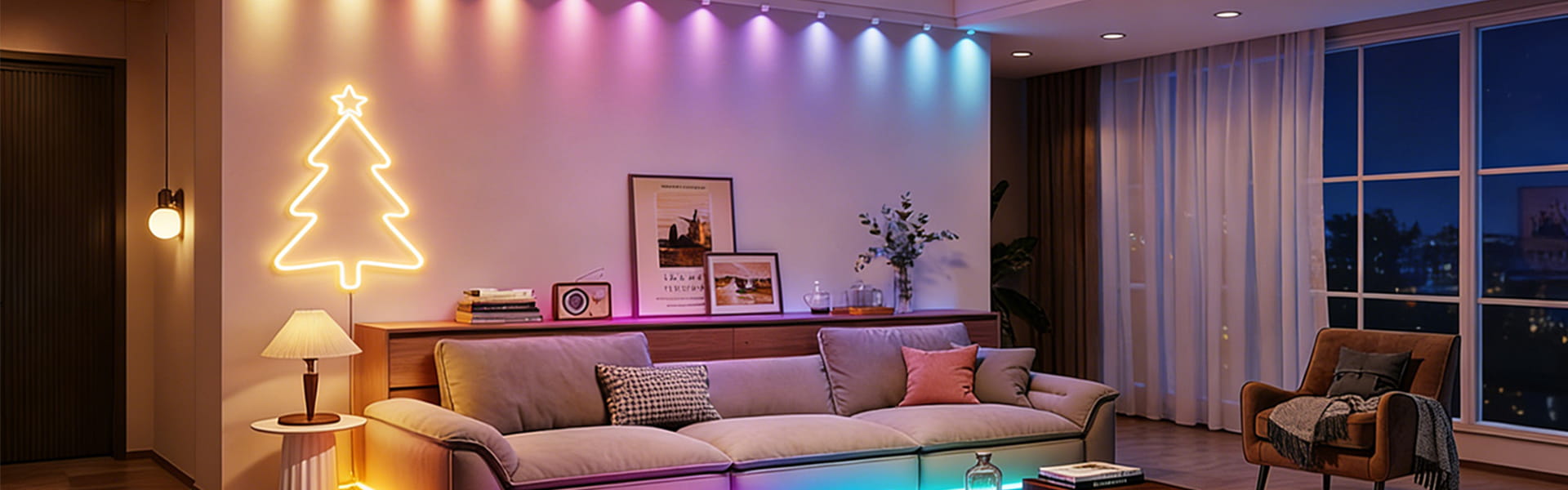
OEM lighting projects are no longer defined by hardware manufacturing alone. As connected lighting becomes standard across residential, commercial, and entertainment environments, the value of a project increasingly depends on how well hardware, software, and system integration work together. The best OEM Smart Lighting solution is one that combines stable hardware, flexible software architecture, and scalable platform capability into a unified system.
The global smart lighting market continues to expand as part of the broader smart home industry, which reached USD 127.8 billion in 2024 and is expected to grow significantly over the next decade. At the same time, IoT Analytics reports that connected devices exceeded 18.5 billion units worldwide, highlighting the importance of interoperability and system-level design. In this environment, OEM projects require more than product supply. They require a complete and adaptable ecosystem.
A reliable OEM solution must go beyond standard manufacturing. It should support full lifecycle development, from concept design to mass production and system deployment. This includes hardware customization, software development, communication protocol selection, and integration with broader IoT environments.
A professional custom lighting system provider typically offers:
Hardware design and engineering support
Firmware and control logic development
Mobile app customization
Cloud platform integration
Multi-device synchronization capability
Compliance with international connectivity standards
This structure allows OEM buyers to build products that are not only functional but also competitive in terms of user experience and scalability.
Modern lighting projects require seamless connectivity across multiple devices and platforms. A smart lighting integration platform ensures that lighting products can communicate with mobile apps, sensors, gateways, and cloud services in a stable and efficient way.
Integration is especially important for projects that involve multiple zones or dynamic lighting effects. For example, coordinated control across LED strips, ceiling lights, and ambient lighting requires synchronized signal processing and consistent response timing. Without a strong integration layer, even high-quality hardware may fail to deliver a smooth user experience.
A structured approach to OEM smart lighting system development helps ensure product consistency and long-term performance. The process typically includes the following stages:
| Stage | Description |
|---|---|
| Requirement analysis | Define product positioning, target market, and system architecture |
| Hardware design | Select controllers, drivers, and lighting components |
| Software development | Build app interface, control logic, and communication protocols |
| Integration testing | Ensure compatibility across devices and platforms |
| Mass production | Scale manufacturing with quality control processes |
| System deployment | Support installation, updates, and long-term maintenance |
Each stage must align with the overall system strategy to avoid compatibility issues and performance gaps.
In many OEM projects, controllers play a central role in system performance. Devices such as the Smart LED Strip Light Controller enable precise signal control, dynamic lighting effects, and synchronization across multiple LED segments. These controllers are essential for applications that require RGB or RGBIC effects, scene transitions, and real-time response.
When combined with advanced algorithms and stable communication protocols, controllers can significantly enhance the visual and functional value of a lighting system.
Connected lighting is part of a larger IoT ecosystem. A strong custom IoT lighting project solution must support integration with smart home platforms, sensors, and automation systems. This allows lighting to respond to environmental conditions, user behavior, and scheduled events.
Industry standards such as Matter are accelerating this trend. The Connectivity Standards Alliance describes Matter as a unified protocol designed to improve interoperability across smart devices. Google highlights that Matter allows devices to connect across ecosystems using a single protocol, reducing development complexity and improving compatibility.
For OEM projects, this means future-ready products must be designed with integration in mind from the beginning.
Surplife positions itself as a system-oriented solution provider, combining hardware manufacturing with software development and platform integration. Its capabilities include AI smart control, IoT platform compatibility, RGBIC lighting algorithms, and multi-device synchronization.
The company supports OEM and ODM customization across different application scenarios, including residential lighting, commercial environments, and immersive entertainment spaces. By offering both hardware components and system-level solutions, Surplife helps ensure that OEM projects can scale from single products to complete lighting ecosystems.
Choosing the right solution requires evaluating multiple dimensions:
System stability and performance
Flexibility of app and software customization
Integration capability with IoT platforms
Scalability across product categories
Manufacturing and supply chain reliability
A solution that balances these factors can support both immediate product launch and long-term business growth.
The best smart lighting solution for OEM projects is not defined by a single product or feature. It is defined by how well hardware, software, and system integration work together to create a reliable and scalable ecosystem.
As connected lighting continues to evolve, OEM buyers are placing greater emphasis on system architecture, customization capability, and integration readiness. A complete solution enables better product differentiation, improved user experience, and stronger long-term competitiveness in the global market.
Previous: