
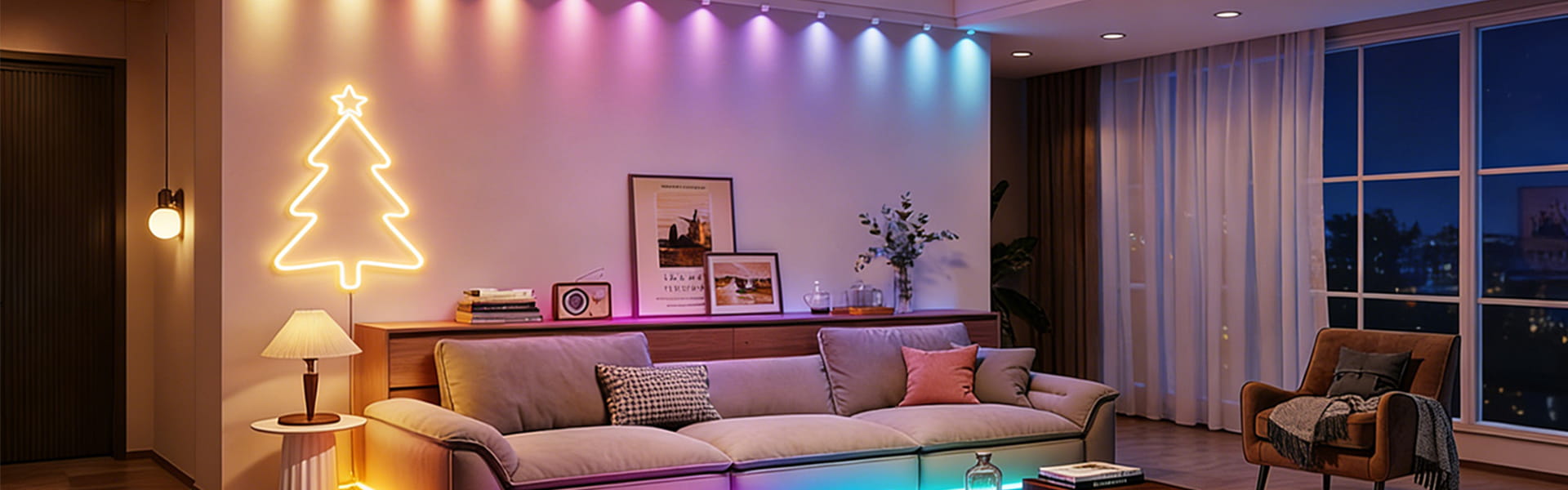
RGB smart light bulbs are often associated with colorful scenes and decorative effects, which leads many users to question whether they are practical for everyday lighting. In real home environments, daily lighting places higher demands on comfort, stability, and usability than on visual effects alone.
This article examines how RGB smart light bulbs perform in daily use, where they fit well, where limitations may appear, and how to evaluate them properly. It also explains how Surplife positions RGB smart bulbs within a complete Smart Lighting system that supports both residential users and B-end customers planning scalable lighting solutions.
RGB smart bulbs typically operate in two distinct modes: white light mode and color mode.
For daily lighting, white light mode is the primary setting. In this mode, the bulb uses dedicated white or combined LED channels to produce warm, neutral, or cool white light suitable for long-term use. Color mode is activated only when users select specific colors or scenes.
In well-designed RGB smart bulbs, switching between these modes is seamless, allowing one bulb to cover both functional lighting and occasional ambient use without compromising stability.
| Aspect | RGB Smart Bulbs | White-Only Smart Bulbs |
|---|---|---|
| Daily white light use | Supported when CCT control is stable | Fully optimized for white light |
| Color flexibility | Wide color range available | No color output |
| Scene versatility | Suitable for both functional and ambient scenes | Limited to brightness and CCT |
| Comfort for long use | Depends on white-light channel quality | Generally consistent |
| Use as main light | Suitable with proper brightness and CCT range | Commonly used as main light |
This comparison shows that RGB bulbs can be suitable for daily lighting when their white-light performance meets practical requirements.
For RGB smart bulbs to work well as daily lighting, brightness and comfort are critical.
A suitable RGB bulb should provide enough luminous output to function as a primary light source rather than only as accent lighting. Smooth dimming behavior and stable low-brightness performance are especially important in living rooms and bedrooms.
Comfort depends less on color capability and more on how well the bulb maintains consistent white light output during extended use. RGB bulbs designed primarily for decoration may fall short here, while system-oriented products are built to support continuous operation.
Daily lighting relies far more on color temperature control than on RGB color selection.
A usable RGB smart bulb should support a practical CCT range that covers warm white for evenings, neutral white for general use, and cooler tones for task-oriented periods. These settings should behave consistently across repeated adjustments.
RGB color effects are typically used occasionally, while white light modes handle most daily lighting hours. For this reason, evaluating the white-light performance of an RGB bulb is more important than evaluating its color palette.
RGB smart bulbs perform well in spaces where lighting needs change frequently or where both functional and ambient lighting are desired.
Common examples include:
Living rooms that shift between relaxation and social use
Bedrooms that use soft lighting at night and brighter light during the day
Multi-purpose rooms that benefit from scene-based lighting
In spaces such as kitchens or work-focused areas, RGB bulbs are suitable only when their brightness and white-light quality meet daily requirements.
In homes and project-based environments, consistency between bulbs is essential.
When multiple RGB bulbs are grouped together, brightness and color temperature should match closely to avoid visible variation. This is especially important in open spaces and multi-room layouts.
For B-end buyers planning residential projects, serviced apartments, or long-term rental properties, RGB smart bulbs are suitable only when they offer predictable white-light behavior and stable grouping performance. As a manufacturer and solution provider, Surplife designs RGB smart bulbs to operate within a unified control ecosystem, supporting consistent output across multiple units and lighting categories.
Rather than focusing on color count or effects, buyers should evaluate RGB smart bulbs based on daily performance criteria:
Usable brightness range for main lighting
Stability at low brightness levels
Practical and adjustable color temperature range
Consistent behavior across grouped bulbs
Reliable integration with scenes and schedules
Products that meet these conditions can serve as everyday lighting rather than occasional decorative elements.
Surplife positions RGB smart light bulbs as part of a complete smart lighting portfolio rather than standalone novelty products.
By aligning RGB bulbs with smart ceiling lights, downlights, and floor lamps under the same control structure, Surplife supports lighting setups where RGB bulbs contribute to daily lighting comfort while remaining available for ambient or scene-based use. This approach benefits both individual homeowners and customers managing bulk purchase or project-based lighting deployments.
RGB smart light bulbs can be suitable for daily lighting when their design prioritizes white-light performance, brightness stability, and consistent control behavior. Color capability adds flexibility, but it should complement rather than replace functional lighting requirements.
When evaluated correctly and used within a coordinated smart lighting system, RGB smart bulbs can support everyday living while offering additional flexibility for changing moods and activities. With a structured product range and experience supporting both residential users and scalable projects, Surplife enables RGB smart lighting to function reliably in real daily environments.