
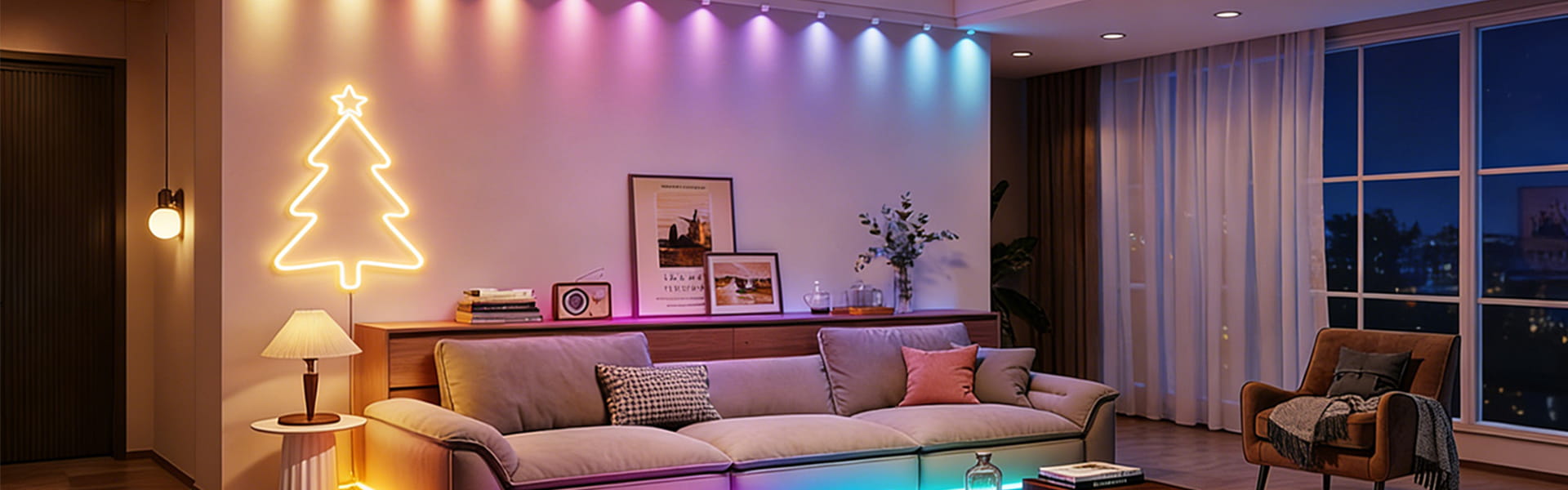
Smart ceiling lights have moved from being a design upgrade to becoming a practical, everyday lighting solution in modern homes. They can deliver uniform illumination for shared spaces, reduce clutter from lamps, and support flexible lighting modes for different routines. Still, not all smart ceiling lights perform the same in real use. Some look great on paper but feel slow, uneven, or inconvenient after installation. This guide explains what to evaluate before buying smart ceiling lights, with a focus on long-term comfort, stable control, and practical installation.
A smart ceiling light should first succeed as a ceiling light. Smart features only matter if the basic lighting quality supports daily life.
Start with these fundamentals:
Brightness output for the room size
Ceiling lights often serve as the main light source. A light that is underpowered forces users to run it at maximum, which reduces comfort and eliminates flexibility. Look for products designed to cover the full room rather than only Decorative Lighting.
Uniform light distribution
Uneven lighting creates hotspots and shadows, especially in open spaces. A well-designed diffuser and optical structure creates smoother coverage across the room.
Color temperature range
Adjustable CCT helps match lighting to activity. Warm tones suit evenings and bedrooms, neutral tones suit general living, and cooler tones suit task-heavy spaces such as kitchens and study areas.
Color accuracy for real interiors
Higher color fidelity supports natural-looking skin tones, food appearance, and décor colors. This is often overlooked, but it affects how a home feels day after day.
Smart ceiling lights rely on connectivity, and your daily experience depends heavily on the control method.
Consider:
WiFi control for whole-home and remote access
WiFi-based lights can fit homes where users want control from different rooms and sometimes outside the home. It also supports broader system-style control when multiple spaces are involved.
Bluetooth or Bluetooth Mesh control for fast local response
Bluetooth-based control often feels quick in-room. Mesh-style setups can support broader coverage with stable grouping when many lights are installed.
Dual-mode flexibility
Some homes benefit from more than one control path for smoother pairing and better adaptability during network changes.
Also check the control experience itself:
How easy it is to set up rooms and groups
Whether the app supports schedules and scenes in a clear way
Whether multiple family members can control the same lights without constant re-pairing
Surplife offers smart ceiling lights as part of a wider Smart Lighting ecosystem, which helps keep control consistent across different product types rather than mixing unrelated systems.
Many buyers assume dimming is a basic feature, but dimming quality varies widely.
Look for:
Smooth dimming steps
Good dimming feels gradual and stable rather than jumpy or inconsistent.
Low-brightness usability
A ceiling light that cannot dim comfortably low is less useful at night. Low-level lighting supports winding down without harsh glare.
Scene behavior that stays consistent
Scenes should not require constant re-adjustment. If a scene is set for “Evening,” it should look the same tomorrow night as it does today, across all lights in the room.
If you care about multi-zone atmosphere in open areas, choose ceiling lights designed to work well with grouping and scene presets rather than treating every light as a standalone device.
A smart ceiling light can be excellent in performance yet become a headache if installation details are ignored. Evaluate fit before buying.
Key points to check:
Fixture size and room proportion
The diameter and profile thickness affect both light coverage and visual balance. A light that is too small can look lost while also producing uneven illumination.
Mounting type and ceiling box compatibility
Some homes use standard junction boxes, while others have different mounting patterns. Confirm whether the fixture supports your ceiling structure and wiring layout.
Heat management and ventilation
Ceiling fixtures run for long hours. Proper thermal design helps maintain stable brightness and longer component life.
Ceiling height considerations
Low ceilings benefit from slim profiles and controlled glare. Higher ceilings often need stronger brightness output and wider distribution.
Surplife can support selection across different room needs by offering multiple ceiling-light styles and matching smart products, so homeowners can keep a consistent experience across rooms rather than improvising with mismatched fixtures.
Smart ceiling lights often list many features, but practical evaluation gets easier when you compare a few consistent criteria.
| Evaluation Area | What to Check | Why It Matters in Daily Use |
|---|---|---|
| Main brightness | Output suited to room size | Avoid constant max brightness operation |
| Uniformity | Diffuser and optical design | Reduces hotspots and harsh glare |
| CCT range | Warm to cool adjustment | Supports different routines and seasons |
| Dimming | Smoothness and low-level stability | Improves comfort at night and for relaxation |
| Group control | Rooms, zones, multi-device sync | Keeps multi-light spaces consistent |
| Scheduling | Timers, repeated routines | Reduces manual interaction |
| Build design | Heat control, stable structure | Supports long-term reliability |
| App experience | Setup, sharing, usability | Prevents frustration after installation |
If you are planning a larger home upgrade or a multi-room renovation, this comparison style also helps during a bulk purchase evaluation, since it keeps the decision based on user experience rather than feature lists.
Ceiling lights are installed for long-term use, and smart ceiling lights should be evaluated with the same mindset as any core home fixture.
Focus on:
Stable materials and finish
A ceiling light sits in a visible, central position. A finish that ages poorly becomes noticeable over time.
Electrical safety and component stability
Smart ceiling lights contain drivers and control modules. Stable power management supports consistent brightness and reduces unexpected issues.
Firmware and product continuity
Smart lighting is not only hardware. Choose products from a supplier that can maintain product consistency, provide documentation, and support future additions to the same system.
Surplife supports modern home lighting projects with a complete product range and structured support, including consistent model availability, product selection guidance, and practical assistance for scaling lighting across rooms. For project-based lighting needs, Surplife can also support product matching across different fixture types to keep installation style and control behavior aligned.
A smart ceiling light is often part of a broader home plan rather than a single purchase. Many users start with one room, then expand to other spaces after they are satisfied with the experience.
Surplife helps build that long-term confidence by providing:
A complete smart lighting portfolio
Smart ceiling lights can be matched with smart bulbs, downlights, and decorative lighting under a consistent ecosystem approach.
Multiple options for different rooms and styles
Homes rarely use one fixture type everywhere. A wider selection helps keep performance consistent while adapting to room needs.
Support for selection, setup logic, and expansion planning
Buyers often want a clear path for adding more lights later without changing the control experience.
Supply and product consistency for ongoing upgrades
This is valuable for homeowners who expand room by room, and also for buyers who treat Surplife as a solution provider for structured lighting rollouts.
Smart ceiling lights are worth evaluating carefully because they often become the main lighting layer in a home. Focus on lighting quality, control stability, dimming performance, installation fit, and long-term reliability. Compare models using a consistent checklist so the decision stays grounded in daily experience rather than feature marketing.
Surplife supports modern home lighting with a full range of smart products, practical selection support, and a system-style approach that helps homeowners and project buyers keep lighting consistent, comfortable, and easy to manage across multiple rooms.