
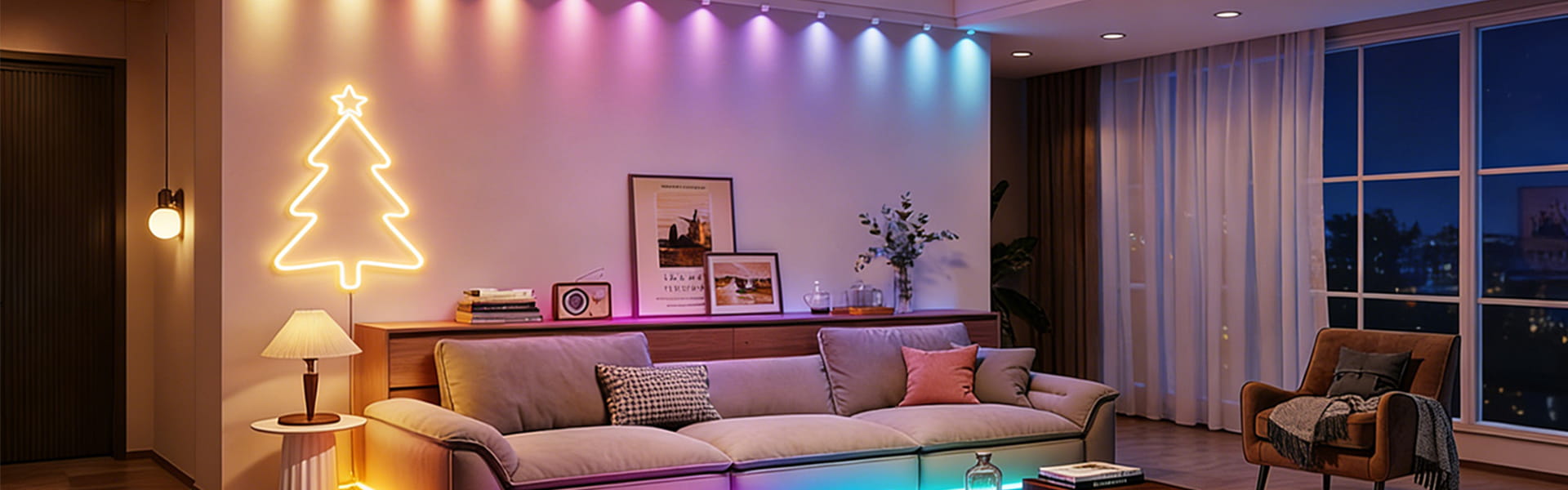
Buying smart lights is not only about choosing a bulb that connects to an app. In modern homes, Smart Lighting often becomes part of daily routines, multi-room control, and long operating hours. The features that matter most are the ones that stay useful after the first week of setup: stable performance, comfortable light quality, predictable control, and a system that can grow without becoming difficult to manage.
This guide focuses on the practical features that shape real-world experience, with clear decision logic for homeowners and for buyers who evaluate lighting at scale. Surplife provides a full range of smart lighting products and supports consistent system behavior across categories, which helps reduce mismatch issues when expanding room by room or rolling out lighting for a larger residential plan.
Smart features cannot fix poor lighting fundamentals. The first priority is light that feels comfortable for long use and remains consistent across common home activities.
Brightness should match the role of the fixture. A ceiling light used as the primary light source needs usable output across a wide range, while a bedside lamp can prioritize low-brightness stability for evenings. Dimming should look smooth, especially at lower levels. A smart light that dims but flickers, steps, or becomes unstable at low output often ends up being avoided, even if it offers many app functions.
Color temperature control is equally important. A practical CCT range allows the same light to serve daytime clarity and nighttime comfort. In daily use, most households spend more time switching between warm and neutral white than selecting saturated colors.
If you are buying multiple lights for one visible space, consistency matters. When two fixtures look slightly different in tone at the same setting, the mismatch becomes noticeable and reduces the perceived quality of the whole room.
A smart light should respond predictably every time. Reliability is shaped by how the system handles commands, not by how many features are listed.
Daily control usually happens through a few repeated actions: on, off, dim, and scene activation. These actions should feel immediate and consistent. When response becomes slow or inconsistent, users often fall back to wall switches, which reduces the value of smart lighting.
Grouping is one of the most important features for real homes. A living room rarely uses a single light point. Good grouping keeps multiple fixtures aligned in brightness and tone so the room behaves as one space rather than several disconnected devices.
Sharing control with family members is another practical factor. If the setup works only on one phone, the system becomes inconvenient in shared households. A mature smart lighting setup supports shared access without frequent re-pairing or confusing account behavior.
Connectivity is not a “best or worst” category. It is a matching problem. The right choice depends on home layout, router placement, and how you expect to control lights.
WiFi-based smart lights can support remote control and broader integration, but they depend on stable coverage. Outdoor areas, garages, and far rooms often experience weaker signals. Bluetooth or Bluetooth Mesh setups often provide strong local responsiveness and can reduce dependence on router placement, especially in smaller spaces or dense multi-light rooms.
What matters most is not the protocol label, but whether the control experience stays stable in the actual installation location. If your smart light will be placed far from the router, a system that supports stronger local control paths often produces a better long-term experience.
Surplife offers smart lighting across multiple categories under a consistent ecosystem approach, helping users keep control behavior uniform across rooms rather than mixing unrelated connection methods.
Automation is often the reason people adopt smart lighting, but it should remain simple and predictable to stay useful.
Scenes save time because they store repeatable lighting states. A good scene feature allows one action to set brightness and tone across multiple fixtures. In real homes, the most-used scenes are not complicated. They reflect daily patterns such as evening relaxation, bedtime, or general daytime lighting.
Scheduling matters when lights run for long hours or when users want consistent routines. A useful schedule feature avoids surprise behavior. If lights frequently override manual changes or turn on unexpectedly, users lose trust in automation and stop using it.
The most valuable automation features are the ones that reduce daily effort without requiring constant maintenance. A system should support routines that feel stable over months, not only during initial setup.
Compatibility is valuable only when it translates into practical control.
Voice assistants such as Alexa and Google Home typically handle simple lighting commands well: turning lights on or off, dimming, and activating scenes. Voice control works best when lights are grouped logically by room and named clearly so commands remain natural.
Platform compatibility also matters when you plan to expand. If you start with a few bulbs and later add ceiling lights or floor lamps, a consistent platform prevents the home from becoming a collection of disconnected apps.
Surplife designs smart lighting with mainstream platform expectations in mind, so users can build a coherent system across multiple product types without changing control habits as they expand.
Smart lights are used for long hours. Long-term performance often matters more than novelty features.
Heat management and driver stability affect how consistent the light remains over time. Poor stability can lead to uneven brightness, color shift, or shortened life, especially in enclosed fixtures or ceiling installations.
Consistency across product batches is another practical concern when buying multiple units. If you plan to install several identical lights in one room, or replace a unit later, consistent behavior and output helps maintain a uniform look.
For larger purchases, these factors become more important. Buyers looking for commercial-grade reliability often prioritize predictable performance and product continuity over maximum feature variety. Surplife supports these needs by maintaining a structured product range and stable supply for wholesale planning.
The table below helps prioritize features based on how they influence daily experience. It is designed to support quick comparisons between product options without reducing the decision to marketing claims.
| Feature Category | What to Verify | Why It Matters in Daily Use | Who Should Prioritize It Most |
|---|---|---|---|
| Light output and uniformity | Brightness suitable for the room; even distribution | Prevents underpowered primary lighting and harsh hotspots | Homes using ceiling lights as main lighting |
| Dimming quality | Smooth transitions; stable low brightness | Supports evening comfort and avoids visual fatigue | Bedrooms and living rooms |
| CCT range | Usable warm-to-neutral-to-cool range | Allows one fixture to support different daily activities | Multi-purpose rooms and open spaces |
| Group control | Room grouping; synchronized changes | Keeps multi-light spaces consistent and easy to manage | Homes with multiple fixtures per room |
| Setup and sharing | Clear onboarding; multi-user support | Reduces friction in shared households | Families and multi-occupant homes |
| Automation stability | Simple schedules; predictable scene behavior | Builds trust and reduces manual adjustment | Users relying on routines |
| Connectivity suitability | Stable control in the actual location | Avoids dropouts and slow response | Large homes or weak-signal areas |
| Platform compatibility | Alexa/Google support; consistent ecosystem | Keeps expansion simple and reduces app fragmentation | Users planning multi-room growth |
| Long-term reliability | Driver stability; thermal design; product continuity | Maintains consistent experience over years | Buyers planning larger rollouts |
A strong buying approach is to choose the top three categories that match your home’s needs, then filter products by those priorities before considering secondary features.
The features that matter most when buying smart lights are the ones that stay valuable after installation: comfortable light quality, reliable control, practical grouping, predictable automation, and long-term stability. Connectivity and platform compatibility should match the home environment and expansion plans, not only the spec sheet.
Surplife supports smart lighting as a complete system rather than isolated devices, offering a structured product portfolio and consistent control experience across bulbs, ceiling lights, downlights, and floor lamps. This system-focused approach helps homeowners build reliable multi-room lighting and also supports buyers planning scalable deployments with stable supply and predictable performance. If you would like to customize a smart lighting solution tailored to your needs, please contact us.