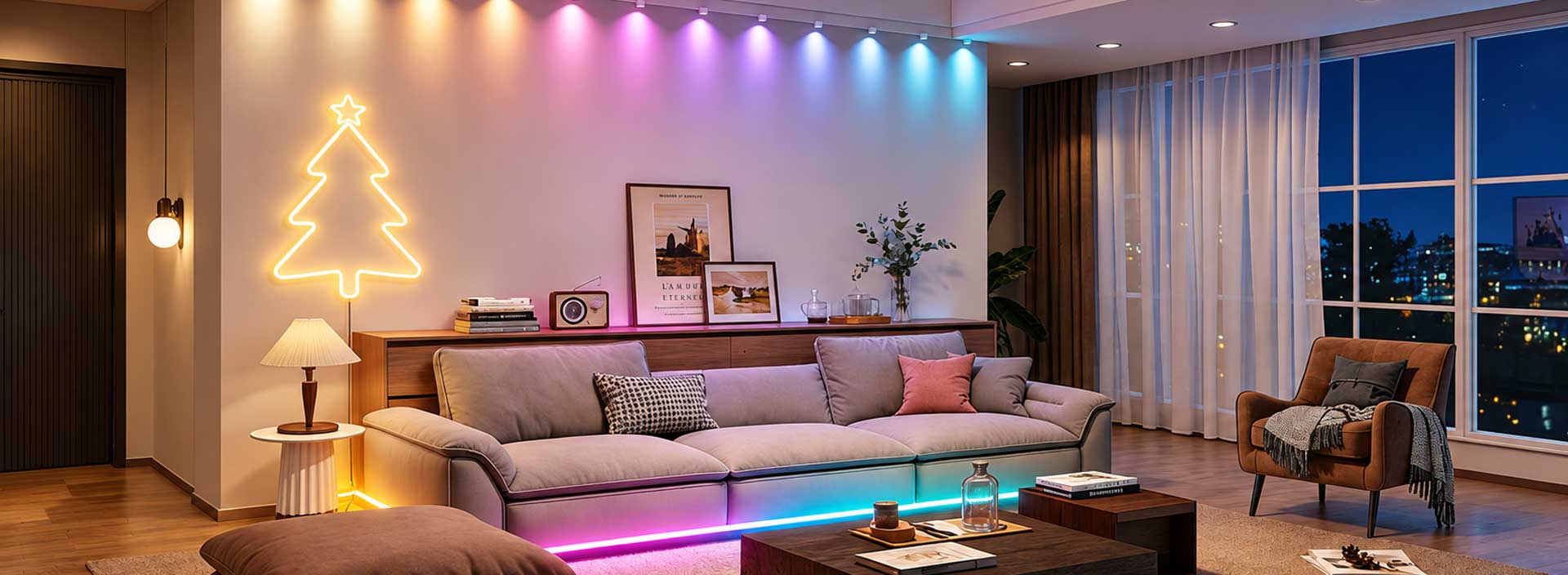
A smart led strip lighting system combines flexible LED strips, a power supply, controller, communication module, firmware, mobile application, and sometimes cloud services. Commands created in the app are transmitted to the controller, which converts them into brightness, color, scene, timing, or segmented-effect changes along the strip.
When a user selects a color or scene, the application packages the instruction into a control command. That command reaches the strip through the configured communication path, such as a direct local connection or a network-based platform.
The controller interprets the command and adjusts electrical signals sent to the LEDs. Standard RGB strips generally change the whole strip to the same color, while addressable or RGBIC structures can control multiple sections independently.
This difference affects how smart LED strip lights work. Flowing colors, chasing effects, gradients, and segmented animations require compatible LEDs, controller capacity, firmware algorithms, and app controls. Software cannot create an effect that the physical strip and controller do not support.
| Component | Primary Function | Key Purchasing Consideration |
|---|---|---|
| LED strip | Produces light and color | LED type, density, and structure |
| Power supply | Provides operating power | Match with strip length and load |
| Controller | Executes lighting commands | Supported colors and effects |
| Communication module | Connects strip with control system | Protocol and market compatibility |
| Firmware | Manages local product behavior | Stability and update support |
| Application | Provides control interface | Pairing and usability |
| Cloud platform | Enables remote services | Security and service availability |
Manufacturers must validate these elements as one configuration. Replacing a controller, communication module, or strip structure may change effect performance even when the exterior product remains unchanged.
app controlled led strip lights may support on/off control, dimming, RGB color selection, adjustable white light, timers, schedules, music response, scene libraries, and custom effects. The available functions depend on the product specification.
During onboarding, the application identifies the device and loads its supported control profile. A properly configured interface should display only relevant functions. Showing segmented controls for a non-addressable strip, for example, creates confusion and unnecessary support requests.
The app may also save favorite scenes, organize strips by room, share control with other accounts, or coordinate several products. Remote access requires communication through the connected platform rather than only a direct local link.
The controller is the operating center of the LED strip lighting control system. It receives commands, regulates output channels, stores certain settings, and determines how effects are reproduced.
Controller selection should consider:
Strip type and channel configuration
Required lighting length and electrical load
Dimming and color-control accuracy
Number and complexity of effects
Music or audio-visual synchronization
Communication requirements
Power recovery behavior
Firmware update capability
Poor matching may cause flickering, incorrect colors, unstable effects, delayed response, or inconsistent brightness along the strip.
An iot led lighting solution can place several compatible strips inside one room, group, or scene. The platform sends coordinated commands so the products activate together.
Synchronization quality depends on network conditions, controller response, firmware logic, and platform routing. Testing one strip cannot confirm multi-device performance. Production-equivalent units should be tested through repeated scene changes, schedules, power interruptions, and network recovery.
Entertainment applications require especially careful timing because visible delays can weaken gaming, music, and home-theater effects.
Evaluation should cover pairing, basic control, dimming, color accuracy, all advertised effects, schedules, remote access, group response, firmware updates, and reconnection. Extended operation can also reveal heat, power, or stability problems not visible during short demonstrations.
Production inspection needs to confirm LED strips, controllers, connectors, power accessories, programmed firmware, labels, and packaging against the approved sample. Different versions must be traceable so later software updates remain compatible.
Smart LED strip performance results from coordinated electrical design, firmware, connectivity, and application development. Managing these layers under one specification creates more consistent effects, easier operation, and a stronger foundation for expanding the connected lighting range.