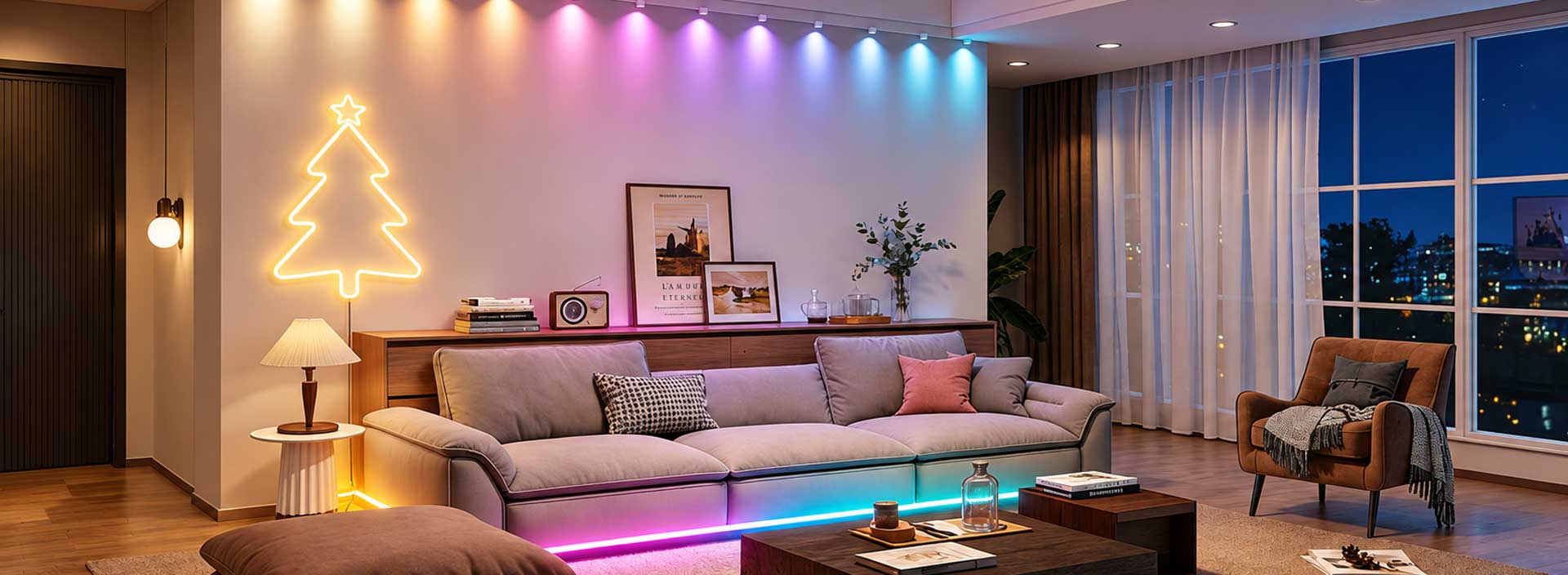
The Smart Lighting software role is to connect users, lighting hardware, firmware, cloud services, automation, and external platforms through one controllable system. Software turns electrical lighting products into responsive devices that can be grouped, scheduled, synchronized, updated, diagnosed, and adapted to different activities or operating environments.
Users rarely separate an LED light from its application and connection process. Pairing speed, interface clarity, command response, scene selection, and recovery after interruption all affect how they judge the complete product.
lighting control system software typically manages:
Device discovery and onboarding
On/off and brightness adjustment
Color and color-temperature control
Rooms, groups, and device sharing
Timers, schedules, and countdowns
Dynamic scenes and music effects
Remote control and account access
Firmware updates and diagnostics
Voice and third-party integration
Hardware may determine the physical lighting capability, but software determines whether that capability is easy to find and use.
Connected lighting becomes more valuable when products operate together. A home theater may combine light strips, bars, and room lighting, while a commercial installation may manage several zones through one schedule.
Software defines which devices can be grouped, which commands they share, and how differences between product categories are handled. It also influences timing. Poor command coordination can cause lights to change at visibly different moments, weakening an entertainment scene or commercial presentation.
Multi-device tests must therefore include production-equivalent units, network interruptions, repeated commands, power recovery, and different group sizes.
iot lighting application development is not limited to interface graphics. Every control shown on the screen must correspond to a supported device command and predictable hardware response.
For example, an RGBIC product may offer segmented colors, flowing effects, direction, and speed. These options require coordination among the LED structure, controller capacity, firmware logic, app interface, and test procedure.
Unnecessary controls can make the product appear complicated. A better approach is to organize functions around recognizable scenarios such as gaming, movies, relaxation, working, holidays, outdoor ambience, or music.
The role of software in smart lighting continues after the first shipment. Over-the-air updates may correct faults, improve stability, add compatible devices, or refine the user experience.
Diagnostic data can help technical teams identify whether a reported problem is related to the network, account, firmware, cloud connection, or physical product. Version records also allow manufacturers to connect specific hardware batches with the correct firmware and application behavior.
Software therefore contributes to development, daily operation, after-sales support, and future product expansion.
| System Area | Software Contribution | Manufacturing Requirement |
|---|---|---|
| Pairing | Guides connection and registration | Correct device identity and firmware |
| Control | Sends and confirms commands | Verified controller response |
| Scenes | Coordinates colors and effects | Consistent lighting structure |
| Automation | Executes schedules and triggers | Reliable device status reporting |
| Updates | Delivers firmware releases | Traceable hardware versions |
| Compatibility | Links external platforms | Tested commands and regions |
| Diagnostics | Records useful operating data | Clear version and batch records |
This relationship explains the smart lighting software system importance: software quality depends partly on how well the factory manages electronics, programming, device identification, and testing.
White-label or customized applications may incorporate brand logos, interface colors, scene libraries, product categories, languages, service information, and operational tools. The design should remain consistent as the lighting range expands.
Customization needs a controlled scope. Visual changes are generally easier to implement than new communication protocols, automation logic, or unique effect algorithms. Buyers should separate essential launch requirements from functions planned for later updates.
Early confirmation reduces repeated revisions among hardware, firmware, application, packaging, and manual teams.
Application testing on a simulator cannot replace operation with physical products. Pairing, control accuracy, synchronization, reconnection, updates, and third-party commands should be verified on the approved controller and LED configuration.
Pilot production is particularly important because programmed firmware, communication modules, component versions, and assembly differences may affect software behavior. Testing several units reveals batch-level issues that one engineering sample cannot show.
Software is the operational layer that holds a smart lighting ecosystem together. When application design, firmware, cloud services, hardware, and manufacturing follow the same specification, lighting products become easier to operate, expand, update, and support throughout their market life.