
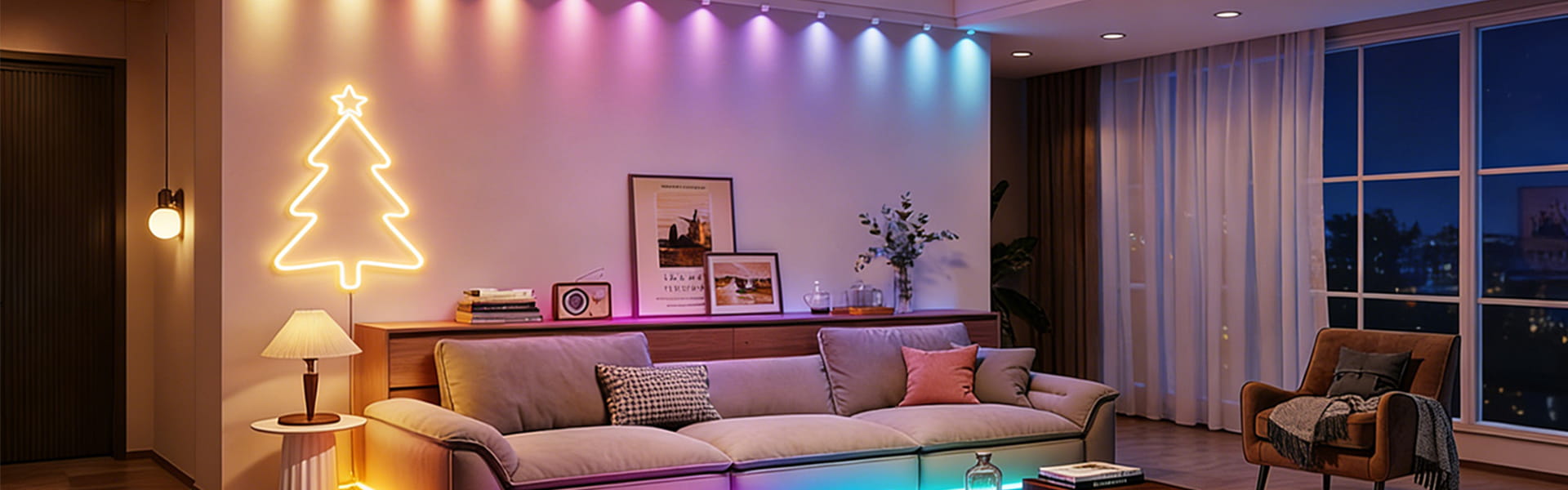
smart mood lights are used to shape how a home feels at different times of day and during different activities. They are not limited to colorful party effects. In everyday home lighting, mood lighting supports comfort, visual balance, and repeatable routines by letting users adjust brightness, color temperature, and color in a controlled way.
Unlike a single fixed bulb that looks the same all day, smart mood lights give a home the ability to shift from bright and practical to soft and calming without changing fixtures. This flexibility is especially useful in modern homes where one room often serves multiple functions, such as working, relaxing, entertaining, and family time.
Surplife offers smart mood lighting across multiple residential categories such as smart bulbs, ceiling lights, downlights, and floor lamps, designed to work within a consistent control experience. Surplife also supports multi-room setups with product selection guidance and stable supply for scalable deployments.
Indoor lighting influences how people experience a space, especially in the evening when artificial light becomes the main source. A room with only strong overhead lighting can feel visually tiring after several hours. A room with only dim ambient lighting can feel unproductive during tasks. Smart mood lights are used to bridge this gap.
Mood lighting supports daily life in three practical ways:
First, it reduces visual stress by allowing lower brightness and warmer tones during rest periods. Many households prefer a softer environment after dinner, and smart mood lighting makes that easy to repeat each day.
Second, it helps a single room support multiple activities. The same living room can shift from a bright “family and cleaning” setting to a relaxed “movie” setting without moving lamps or changing bulbs.
Third, it improves perceived comfort by balancing light distribution. When the main light is reduced and secondary lighting is added, the room often feels calmer without becoming dark.
These are functional outcomes, not decorative language. Smart mood lights are used because they change daily lighting behavior in a predictable and controllable way.
Smart mood lights are typically used in specific home situations where standard lighting feels too rigid. In practice, users rely on mood lighting for repeatable scenarios rather than continuous manual adjustments.
Living rooms often use mood lighting to support evening relaxation, social gatherings, and television viewing. A softer light level with warmer tones reduces harsh reflections on screens and reduces contrast across the room.
Bedrooms use mood lighting to support wind-down routines. Lower brightness at night supports comfort and reduces the urge to keep overhead lighting on. Some users also rely on gentle morning lighting to avoid sudden brightness upon waking.
Dining spaces use mood lighting to create a comfortable setting during meals. A warmer and slightly dimmed light level can feel more appropriate than bright task lighting, especially for evening dining.
Home offices and study corners use mood lighting to reduce fatigue in long sessions. A balanced, neutral tone for focus can shift to a warmer resting tone afterward, without changing the fixture.
Hallways and night pathways use mood lighting for safe navigation without waking the household fully. Low-level lighting improves visibility while keeping the home calm.
A key point: in daily use, the “mood” is often subtle. Many households spend more time using warm-to-neutral white adjustments than saturated RGB colors.
Smart mood lights create different moods through three controllable dimensions: brightness, color temperature, and color.
Brightness is the most important factor for mood. A moderate reduction in brightness can change how a room feels more than a dramatic color effect. Brightness control also supports comfortable evening lighting, especially in rooms where overhead lights feel intense.
Color temperature influences the perceived warmth of the space. Warmer tones are commonly used at night, while neutral tones are used during the day. Homes that rely on a single fixed color temperature often feel inconsistent across routines, especially when people work in the daytime and relax at night in the same room.
RGB color is used selectively. In daily life, RGB is often used for short periods: weekend gatherings, seasonal decoration, background ambience, or children’s playtime. For many users, RGB is valuable because it is available when needed, not because it is used all day.
The most useful mood lights support stable transitions between these settings. A smart light that changes abruptly or behaves inconsistently across days can feel less comfortable than a simpler light.
Instead of choosing mood lighting by “effects,” it is more reliable to choose based on room function, typical use duration, and how many light points are visible at the same time.
The table below provides practical selection guidance based on common household situations.
| Home Area / Scenario | Typical Mood Goal | Recommended Control Focus | Suggested Fixture Choice |
|---|---|---|---|
| Living room evenings | Comfortable, low-glare environment | Smooth dimming and warm-to-neutral CCT | Smart floor lamp plus ceiling light grouping |
| TV and movie time | Reduce reflections and harsh contrast | Lower brightness with stable warm tone | Floor lamp or indirect mood light near seating |
| Bedroom wind-down | Calm lighting before sleep | Low-brightness stability and warm CCT | Smart bulb in bedside lamp or soft ceiling setting |
| Morning routine | Gentle activation without harsh brightness | Gradual brightness ramp and neutral CCT | Ceiling light with schedule-based transitions |
| Dining at night | Comfortable lighting for meals | Warm CCT with moderate dimming | Ceiling light or pendant with scene presets |
| Study or hobby corner | Clear visibility with reduced fatigue | Neutral CCT with adjustable brightness | Smart desk lamp or focused bulb plus scene control |
| Hallway at night | Safe movement without waking others | Very low brightness, warm tone | Small night scene via grouped bulbs or downlights |
| Occasional gatherings | Flexible ambience | RGB scenes with controlled brightness | RGB-capable bulbs in key locations |
A good approach is to prioritize comfort and repeatability for daily rooms, then add RGB capability where it supports occasional ambience. This avoids paying for features that are rarely used while still keeping the system flexible.
Mood lighting becomes practical when it can be repeated easily. Smart Lighting systems typically rely on scenes, grouping, and schedules.
Scenes store a combination of brightness and color settings. Users activate a scene with one tap rather than adjusting multiple sliders each time. In daily life, scenes are most useful when the same patterns repeat: evening relaxation, dinner, bedtime, or weekend ambience.
Grouping keeps multiple lights consistent in the same space. If a living room uses a ceiling light and a floor lamp together, grouping lets both respond to the same scene. Group consistency matters more in open-plan homes where several fixtures are visible at once.
Automation reduces manual effort. Schedules can shift lighting through the day, while routines can trigger predictable evening settings. This is where smart mood lights often provide the most value for everyday use, since users do not need to think about adjusting lighting every time.
Many households start with manual scene activation and gradually rely on automation once preferred settings are established.
Surplife supports this practical use pattern by offering smart lighting products across categories that can be organized under a consistent control experience, helping users expand from one room to multiple rooms without rebuilding their setup.
Mood lighting is simple with one bulb. It becomes more challenging when several bulbs and fixtures must match.
In multi-light environments, the most noticeable problems come from inconsistency: one bulb looks warmer, another looks cooler, or brightness levels do not align in a group. This is especially visible in open spaces and in homes with multiple ceiling fixtures.
For homeowners, consistency reduces the need for constant re-tuning. For B-end customers planning bulk purchase installations, consistency supports predictable results across units and reduces after-install support.
This is one reason many buyers prefer a supplier that can provide a coherent product range rather than mixing unrelated devices. Surplife acts as a solution provider for smart mood lighting setups by offering a broader portfolio that includes bulbs, ceiling lights, downlights, and floor lamps, along with support for selection and expansion planning. Surplife can also support OEM/ODM requirements for projects that need tailored specifications and stable long-term supply.
Smart mood lights are used in home lighting to support comfort, flexible room usage, and repeatable routines. They help living rooms shift smoothly from bright to relaxing, support bedrooms with calm nighttime settings, improve dining atmosphere through warm and controlled light, and provide safe low-level lighting for night movement.
The most effective mood lighting setups focus on brightness control, usable color temperature adjustment, and consistent behavior when multiple lights work together. RGB color adds value when used intentionally for occasional ambience, not as the default daily mode.
With a complete smart lighting portfolio and practical support for both residential users and scalable deployments, Surplife helps users build smart mood lighting that works reliably across rooms and routines, supporting everyday living as well as project-based lighting needs.