
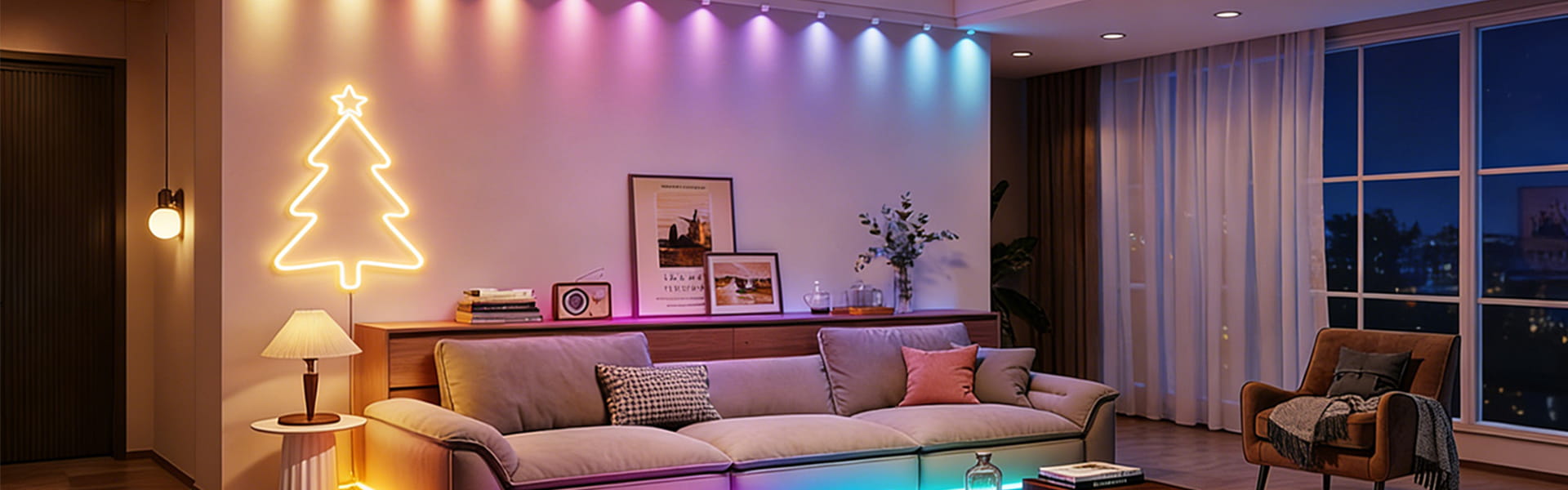
Smart Lighting usually connects in two main ways: WiFi or Bluetooth. Both can dim, change colors, run schedules, and create scenes—but they behave very differently in daily use. If you are choosing products for a home, a rental property, a hospitality space, or a multi-room project, understanding the connection method will help you avoid common setup issues and get the experience you expect.
Surplife’s smart lighting lineup includes WiFi products, Bluetooth Mesh products, and WiFi + Bluetooth dual-mode options across multiple categories such as smart bulbs, downlights, floodlights, ceiling lights, and floor lamps.
WiFi smart lights connect to your home router and can be controlled from anywhere through the internet.
Bluetooth smart lights connect directly to your phone (or through a Bluetooth Mesh network) and typically focus on fast local control without relying on your router.
This difference impacts range, reliability, speed, grouping, and what happens when your internet goes down.
A WiFi smart light joins your 2.4 GHz home network through your router. After pairing, you control it in the app whether you are at home or away, because commands can be routed through your network and cloud services (depending on how the system is designed).
What you can expect:
Remote control when you are not at home
Easier multi-room control when many devices are on the same network
Strong integration potential with automations and schedules
Surplife’s app positioning emphasizes controlling WiFi lighting products, personalization, grouping, timers, music sync, and remote control.
Bluetooth lights pair directly to your phone. Control is local: your phone talks to the light over Bluetooth radio. That makes control feel instant and keeps the experience working even if the internet is unstable.
Bluetooth becomes especially powerful when it is Bluetooth Mesh, where devices relay messages to each other. In the Surplife product category, there are products explicitly designed for Bluetooth Mesh use.
What you can expect:
Very fast response when you are nearby
Works without internet for on-site control
Mesh options can expand coverage and support groups and whole-home behavior
| Topic | WiFi Smart Lights | Bluetooth Smart Lights | What It Means for You |
|---|---|---|---|
| Control range | Whole home via router and remote internet access | Phone proximity or extended coverage via Bluetooth Mesh | WiFi supports remote access, Mesh improves local coverage |
| Away-from-home control | Available | Usually unavailable without a gateway | WiFi suits travel and remote monitoring |
| Setup dependency | Requires router configuration | Faster pairing, minimal router involvement | Bluetooth simplifies installation in limited-network spaces |
| Response speed | Network-dependent | Extremely fast locally | Bluetooth feels more immediate for direct control |
| Multi-room scalability | Depends on router capacity | Mesh scales efficiently in local environments | Planning matters more than device type |
| Internet outage behavior | Remote control stops | Local control usually continues | Bluetooth offers resilience during outages |
| Best use cases | Automation-heavy homes and remote management | Local zones, weak WiFi areas, dense lighting groups | Match connection to environment |
WiFi coverage depends heavily on router placement, wall materials, and network congestion. Bluetooth single-device range is shorter, but Bluetooth Mesh compensates by relaying signals across multiple devices, creating consistent local coverage.
WiFi smart lights share bandwidth with phones, computers, cameras, and streaming devices. Under heavy usage, this can result in occasional delays or reconnection requirements. Bluetooth lighting avoids this issue by operating independently of your WiFi network.
Bluetooth lighting often delivers immediate feedback for on and off commands and dimming. WiFi lighting can be equally capable, but performance depends on network quality and stability.
WiFi smart lights are designed for users who want to manage lighting remotely. Common needs include checking lights while traveling, adjusting outdoor lighting, and maintaining schedules across multiple rooms.
Both WiFi and Bluetooth systems support grouping and scene creation. WiFi relies on consistent network connectivity, while Bluetooth Mesh emphasizes device-to-device synchronization, which can be advantageous in local multi-light setups.
Some Surplife smart lighting products support WiFi and Bluetooth dual-mode operation. This approach allows easier pairing, local control fallback, and more stable use in environments where WiFi conditions vary between rooms.
Remote control outside the home is important
You rely on schedules and routines across many rooms
Your 2.4 GHz WiFi network is stable and well-covered
Centralized app control is a priority
You prefer fast and reliable local control
WiFi access is limited or unstable
You plan to install many lights in close proximity
You want lights to remain controllable during internet outages
Installation flexibility is important
Network conditions may change over time
You want a balance between remote access and local responsiveness
Within Surplife’s smart lighting range, different connection types are available across multiple form factors:
Smart bulbs with WiFi RGB CCT functionality
Bluetooth Mesh candle bulbs for grouped lighting
Smart downlights available in Bluetooth or dual-mode versions
Smart floodlights designed for exterior and wide-area lighting
Smart ceiling lights and floor lamps for extended coverage
A practical strategy is to use WiFi lighting for areas requiring remote control, Bluetooth Mesh lighting for dense local zones, and dual-mode products where flexibility and redundancy are needed.
Yes. Many installations combine both types by zone, assigning WiFi lights to areas needing remote access and Bluetooth Mesh lights to areas focused on local reliability.
WiFi smart lights may require reconnection if the network name or password changes. Bluetooth lighting is unaffected because it does not rely on router credentials.
Bluetooth Mesh systems are designed to scale easily. Each additional device can extend the network, making it suitable for gradual expansion.
Bluetooth pairing is often simpler because it avoids router configuration. Dual-mode products can further reduce setup complexity by supporting multiple onboarding methods.
The difference between WiFi and Bluetooth smart lights directly affects how your lighting system performs every day.
WiFi smart lights excel at remote access and centralized control
Bluetooth smart lights focus on speed, simplicity, and local reliability
Bluetooth Mesh enhances coverage through device-to-device networking
Dual-mode lighting provides flexibility for changing environments
Surplife’s smart lighting portfolio includes WiFi, Bluetooth Mesh, and dual-mode options across multiple lighting categories, allowing you to select the most suitable connection method for each space rather than relying on a single approach throughout the entire project. If you need more information about customized smart lighting solutions, please contact me, and we will provide you with free advice.
Previous: What Are the Benefits of Smart LED Lighting for Home Use?
Next: