Smart Lighting has moved far beyond remote on and off control. In today’s market, the app is the interface that defines how users experience the product, how retailers position the product, and how brands keep customers connected after the first sale. Surplife presents smart lighting as an integrated ecosystem that combines AI smart control, Matter-ready connectivity, cloud platform support, app capability, and AIoT custom solutions. That direction matches broader market movement, as the smart lighting market is estimated at USD 27.52 billion in 2026 and projected to reach USD 67.83 billion by 2031, with control systems among the fastest-growing segments.
For many buyers, lighting performance is no longer judged only by lumen output, color rendering, housing quality, or driver stability. The real comparison often happens at the software layer. A lighting product with weak onboarding, slow response, unstable grouping, or poor scene management quickly loses appeal even if the hardware itself is sound. Surplife describes the app as the software layer connecting hardware, wireless communication, scene settings, user permissions, and cloud management into one operating system. That is why custom lighting app development has become a strategic decision rather than a cosmetic upgrade.
When a brand relies only on generic control software, it loses control over user experience. The interface may look similar to competing products, feature priorities may not match the target market, and long-term product planning becomes dependent on someone else’s roadmap. A custom app changes that. It lets a brand define scene logic, visual identity, user flows, device grouping, firmware update paths, and service extensions in a way that fits its own catalog and channel strategy. Surplife’s customization service specifically highlights branding flexibility, configurable page functions, analytics, operations capability, and end-to-end publishing support.
A shared third-party platform may help products get to market quickly, but it also creates limits. The first limit is differentiation. If multiple suppliers sell products under different names but through nearly identical software, the brand loses identity at the exact point where users interact with it every day. The second limit is data control. App usage data, retention behavior, feature usage, and monetization opportunities all become harder to manage directly. The third limit is product evolution. Lighting categories are now expanding into multi-room scenes, entertainment lighting, architectural accents, office environments, and mixed-device ecosystems. These categories require software flexibility that generic models often cannot provide. Surplife’s own materials position OEM app services as a tool not just for control, but also for service delivery, user operations, and marketing promotion.
This shift is supported by market structure. Mordor Intelligence notes that control systems are set to register the fastest growth within smart lighting, while Wi-Fi represented 49.17 percent of 2025 revenue and Bluetooth mesh is forecast to grow even faster. That means the competitive edge is increasingly tied to how devices are connected, grouped, managed, and updated, not simply how the fixture is manufactured. In that environment, a custom smart lighting app solution helps a brand turn software into a commercial moat.
A tailored app gives lighting brands direct control over five areas that matter in real purchasing decisions.
An app is often the first interface a user remembers. Logo placement, color language, device naming structure, onboarding flow, and scene presentation all influence perceived value. Surplife states that app themes, logos, color schemes, and page functions can be configured according to brand requirements. That makes the app part of packaging, product storytelling, and after-sales consistency rather than a detached utility tool.
A lamp may be purchased once, but the app can keep the user engaged through schedules, scenes, updates, multi-device control, and new feature releases. Surplife emphasizes continuous iterative upgrades as part of OEM app support. That matters because lighting categories increasingly compete on experience over time, especially in homes, gaming rooms, entertainment spaces, smart offices, and decorative environments where repeated interaction is common.
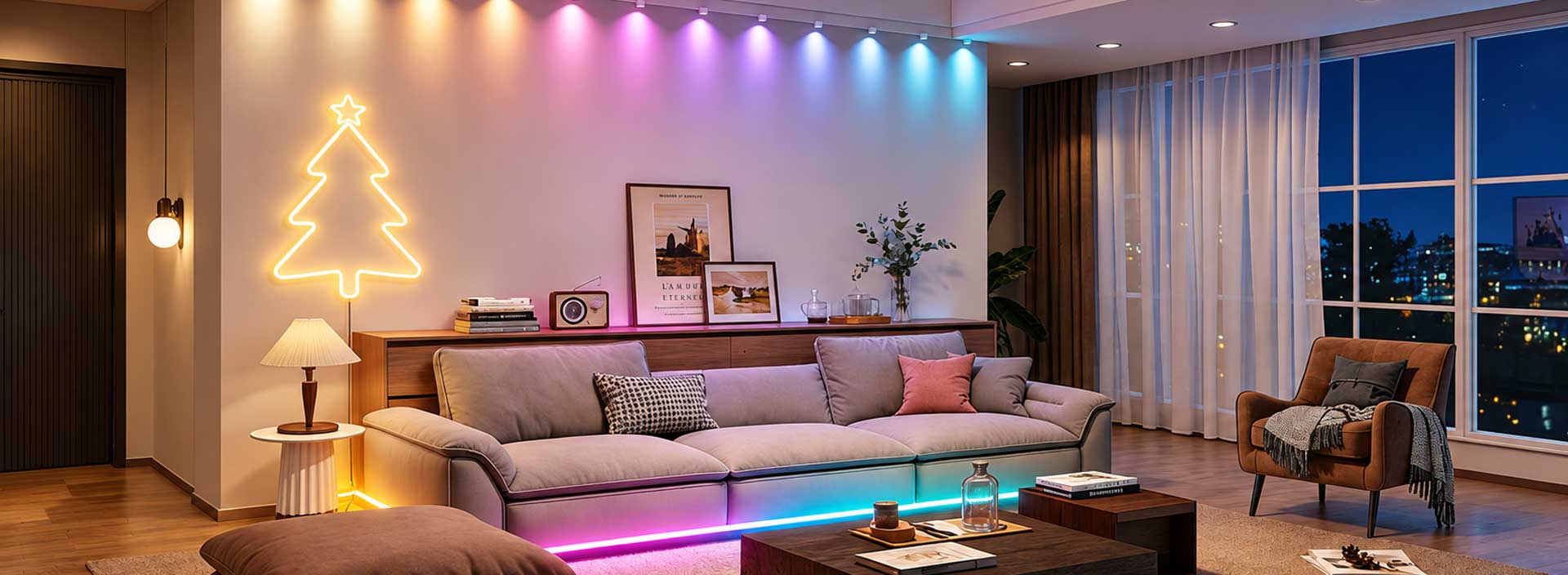
Once a brand owns its software framework, it becomes easier to expand from one SKU to a broader family. Floor lamps, light strips, ambient lights, Decorative Lighting, Permanent Lighting, and Scene Lighting can all sit within one unified control logic. Surplife’s site shows exactly this kind of ecosystem thinking through multiple lighting categories and multi-device sync capability. That creates stronger cross-selling conditions and a more coherent brand platform.
The market is no longer tolerant of isolated smart devices. The Connectivity Standards Alliance describes Matter as a unifying, IP-based connectivity protocol that helps build reliable and secure IoT ecosystems while accelerating paths to market. For lighting brands, that means compatibility is now a core purchase argument. Surplife highlights Matter Universal Connect and IoT platform compatibility, which is especially important for brands that want broader channel acceptance and lower integration friction.
A white label lighting app can help a brand launch faster while still retaining ownership of brand presentation and user-facing experience. This is especially useful when the business model includes regional channels, distributor networks, or different product lines under one corporate group. Surplife’s one-stop process covering planning, development, testing, optimization, and final app store publishing lowers the operational barrier for companies that do not want to build everything internally from zero.
There is a direct connection between app quality and product usefulness. The U.S. Department of Energy states that lighting controls help save energy by automatically turning lights off when not needed and by reducing light levels when full brightness is unnecessary. Control functions such as timers, dimmers, motion sensors, and photosensors are not only hardware features. They need a usable interface to be configured, grouped, and adjusted properly. A strong lighting control app turns those control functions into something practical for the end user rather than buried technical potential.
That link between software and energy value is one reason smart lighting adoption keeps rising. Surplife’s app description covers brightness adjustment, color temperature control, RGB effects, schedules, grouping, automation, and device status management. These are not decorative add-ons. They shape how easily users can implement scenes, reduce waste, and adapt lighting to daily routines across one room or multiple locations. When software is weak, these benefits are underused. When software is well structured, the entire product line becomes easier to understand and easier to keep.
Not every lighting factory can support app work at the same depth. Many can assemble connected hardware, but far fewer can coordinate hardware design, firmware logic, protocol choice, app interface, cloud services, and long-term software maintenance as one system. Surplife frames a strong OEM lighting solution as full lifecycle development, covering concept design, hardware customization, software development, communication protocols, integration testing, mass production, and system deployment. That integrated structure matters because app quality depends on stable collaboration between hardware and software teams.
A capable partner should also understand that app development is not limited to screens and icons. It includes device provisioning, connection reliability, scene synchronization, response timing, permissions, firmware upgrade management, and data feedback. Surplife additionally highlights RGBIC lighting effect algorithms, cloud platform capability, multi-device synchronization, and AI smart control. These capabilities show that the company is not treating software as an outsourced afterthought, but as part of the product architecture itself.
Private label expansion in smart lighting has become more demanding. Buyers want faster product refresh, stronger retail identity, and better control over long-term customer experience. A generic app may support launch speed, but it rarely supports long-term differentiation. By contrast, lighting app development for brands creates room for unique onboarding, market-specific features, refined user journeys, and future service modules.
That matters even more as the total smart home market continues to grow. Surplife cites a global smart home market value of USD 127.8 billion in 2024, projected to reach USD 537.27 billion by 2030. In a category of that scale, brands that own their app layer are better positioned to protect identity, optimize retention, and extend value across connected products. This is one reason more buyers now evaluate app capability alongside LEDs, controllers, and industrial design.
| Business need | Why it matters | How Surplife supports it |
|---|---|---|
| Brand differentiation | Distinct user interface helps separate one catalog from generic market offerings | Theme, logo, color scheme, and page function customization |
| Ecosystem readiness | Better compatibility improves channel acceptance and user convenience | Matter Universal Connect and IoT platform compatibility |
| Product expansion | One app can manage multiple device categories and scenes | Multi-device sync across smart lighting categories |
| Retention and service | Updates and operations tools support ongoing engagement | Iterative upgrades plus analytics and operations console |
| End-to-end execution | Reduces coordination gaps between hardware, software, and deployment | Planning, development, testing, optimization, publishing |
Surplife’s advantage is not limited to manufacturing lamps. Its website presents a structure built around integrated solution delivery: AI smart control, Matter connectivity, cloud platform and app capability, AIoT custom solutions, OEM and ODM support, multi-device synchronization, and secure supply chain support. It also covers a broad scene range including home smart lighting, commercial smart lighting, ambient entertainment, smart office use, and other application-based solutions. That combination is valuable because app success depends on system-level thinking, not isolated parts production.
For a lighting brand, the real question is no longer whether an app is needed. The real question is whether the app is strong enough to support market positioning, user retention, future compatibility, and long-term category expansion. A custom approach gives the brand more control over how its products are used, remembered, and scaled. In an industry where the control layer is becoming one of the fastest-growing value segments, owning that layer is becoming a practical growth strategy rather than a premium extra. Surplife’s integrated hardware, software, cloud, and customization capabilities put it in a strong position to support that shift.