
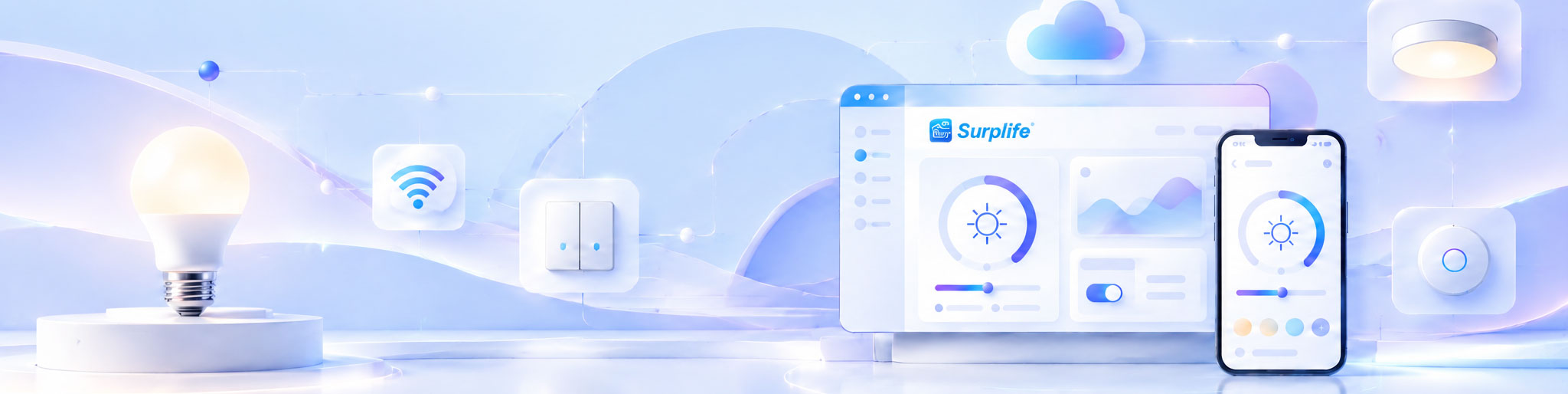
Developing custom Smart Lighting products involves defining product requirements, selecting compatible hardware, planning firmware and app functions, validating prototypes, and preparing for mass production. The process starts with a clear product brief and continues through engineering, testing, and manufacturing approval. The most effective approach is to customize only the features that support the target market, while using proven technologies where practical to control development costs and reduce technical risks.
The first decision is not which controller or LED to use, but what the finished product must achieve. A product designed for decorative home lighting may require different functions from one intended for commercial installations or synchronized gaming setups.
A useful product brief should identify the intended users, target market, lighting functions, control methods, expected order volume, and approximate launch schedule. It should also specify whether the product needs a branded mobile application, remote access, cloud connectivity, or integration with other devices.
These requirements determine the technical architecture. For example, a product that only needs local brightness control may not require the same software infrastructure as one supporting remote management and multi-device synchronization.
Customization can involve the physical product, electronic hardware, control software, or the complete user experience. Each area introduces different engineering requirements.
| Customization Area | Possible Changes | Main Development Consideration |
|---|---|---|
| Product Design | Dimensions, enclosure, connectors, and appearance | Mechanical feasibility and assembly |
| Lighting Performance | Brightness, color output, and dynamic effects | LED characteristics and thermal behavior |
| Electronic Hardware | PCB layout, controller, and power architecture | Electrical design and component availability |
| Firmware | Device logic, control modes, and communication behavior | Stability and hardware compatibility |
| Mobile Application | Branding, interfaces, and control functions | User experience and device integration |
Not every project needs a completely new design. Adapting an existing platform may be sufficient when the required functions are already supported. More extensive customization is appropriate when the product needs specific performance, unique features, or a different hardware structure.
The development process should move through defined stages, with each stage resolving a different category of risk.
Requirements and feasibility: The engineering team reviews the product brief, identifies technical constraints, and determines which components or technologies can meet the requirements.
Design and prototyping: Hardware, firmware, enclosure design, and software interfaces are developed according to the agreed scope. Early samples help verify whether the proposed architecture works in practice.
Integration and validation: The components are tested together. The team checks lighting performance, device communication, app behavior, and relevant safety or compliance requirements.
Production preparation: After the design is approved, manufacturing procedures, inspection criteria, packaging, and component sourcing are confirmed before mass production begins.
The stages may overlap, but critical dependencies should not be skipped. For example, a customized application cannot be fully validated until the relevant device communication and control functions are available.
A common development challenge is treating hardware and software as separate projects. A controller may support the required lighting functions, but the firmware might not expose the commands needed by the app. Similarly, an application may display a control option that the device cannot execute reliably.
To prevent these problems, the hardware, firmware, and app teams should agree on interfaces and expected behavior early in the project.
For an app-controlled LED product, this includes defining how brightness and color commands are transmitted, how device status is reported, what happens when a connection is lost, and how the product behaves after restarting.
An integration prototype should test these interactions before the design is finalized. This approach makes it easier to identify architectural problems before they require expensive revisions across several components.
Testing should verify that the product meets its documented requirements under expected operating conditions. A sample that works during a brief demonstration is not sufficient evidence of production readiness.
The test plan may include electrical performance, lighting output, temperature behavior, connection stability, firmware operation, and compatibility with the intended app or control platform. Applicable safety, electromagnetic compatibility, and wireless requirements should also be assessed for the destination market.
Testing should produce documented results and clear acceptance criteria. When a defect is found, the cause should be investigated, the design corrected where necessary, and the affected tests repeated.
For customized products, the approved sample should be linked to a specific hardware revision, firmware version, and configuration. This helps prevent differences between the sample accepted by the buyer and the units manufactured later.
Working with an experienced smart lighting ODM manufacturer can simplify coordination when hardware, firmware, software, and production must be developed together. However, the value of the partnership depends on the actual capabilities and responsibilities included in the agreement.
Before selecting a partner, clarify which components are developed internally, which functions rely on third-party technologies, and who is responsible for system integration and validation.
The agreement should also address sample revisions, development milestones, component substitutions, source-code ownership or licensing, tooling ownership, warranty terms, and ongoing software maintenance.
A partner should be able to explain the technical trade-offs behind a proposed solution rather than simply promise that every requested function is possible. Early feasibility discussions help establish realistic costs and schedules.
The most effective cost-control measure is to distinguish essential product features from optional enhancements before engineering begins.
Start with the functions required for the initial launch. Reuse proven hardware or software where it satisfies the specification, and introduce additional features only when they provide a clear commercial or technical benefit.
Late changes are particularly expensive when they affect multiple parts of the system. A change to the wireless module, for example, may require hardware revisions, firmware updates, app adjustments, and renewed compatibility testing.
A controlled change-request process should document the reason for each revision and its impact on cost, schedule, and validation requirements.
A product is ready for production when the design has been approved, essential functions have passed validation, applicable compliance requirements have been addressed, and the manufacturing process can reproduce the approved configuration consistently.
The final release should include an agreed specification, approved sample, relevant test records, controlled hardware and firmware versions, and defined quality inspection procedures.
Custom development is most successful when product requirements, engineering decisions, and manufacturing preparation are treated as one connected process. A clear specification and disciplined validation make it easier to create a differentiated product without introducing avoidable cost, delay, or quality risk.