
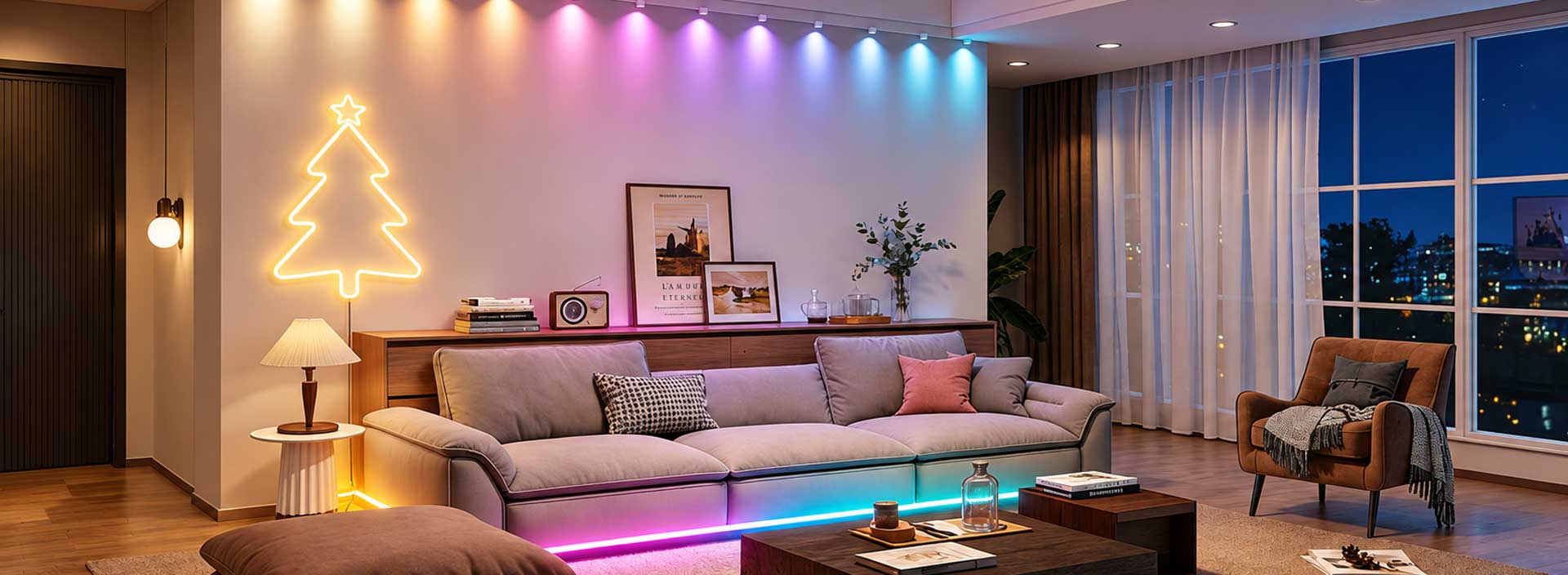
A music sync lighting system analyzes sound or audio signals and converts rhythm, volume, frequency, or timing information into lighting commands. The controller or application then changes brightness, color, movement, or LED segments so that compatible lights respond visually to music during gaming, home entertainment, parties, performances, and commercial ambience.
Music synchronization can begin with a built-in microphone, mobile-device microphone, direct audio input, media application, or another compatible audio source. The selected method affects response accuracy and installation requirements.
Microphone-based products listen to surrounding sound. They are easy to use but may also react to conversations, background noise, or echoes. Direct audio analysis can provide a cleaner signal, although it requires deeper integration with the media source.
The control system continuously samples the incoming sound and identifies changes that can be converted into lighting behavior.
The software or controller may examine several audio characteristics:
Volume: Controls overall brightness or effect intensity.
Beat: Triggers flashes, pulses, or scene changes.
Frequency: Assigns low, middle, or high sounds to different colors or sections.
Tempo: Influences animation speed.
Timing: Coordinates light transitions with the audio sequence.
This is the basic explanation of how music sync lighting works. The algorithm does not simply turn lights on whenever sound is detected; better systems classify audio changes and translate them into structured effects.
Standard RGB lighting commonly changes the entire connected strip or fixture at once. It can pulse, fade, or switch colors with the beat.
RGBIC and other addressable structures allow different segments to respond independently. Colors may travel along the strip, separate frequency ranges may activate different areas, or several effects may appear simultaneously.
Smart Lighting audio sync quality therefore depends on the physical LED structure as well as the software. A segmented animation cannot be produced correctly when the connected hardware only supports whole-strip control.
| Factor | Possible Effect | Evaluation Method |
|---|---|---|
| Audio source | Background noise or signal clarity | Test real operating environment |
| Processing delay | Light responds after the beat | Compare response with rhythmic music |
| Controller capacity | Limits effect complexity | Test all advertised modes |
| LED structure | Determines segmented control | Confirm physical configuration |
| Network route | May add command delay | Compare local and connected operation |
| Algorithm | Changes beat and frequency recognition | Test several music styles |
| Multi-device timing | Produces uneven room effects | Operate several units together |
One demonstration song cannot represent overall performance. Testing should include music with different tempos, frequency ranges, vocal content, and dynamic changes.
LED music lighting control should offer ready-made modes for quick use while allowing adjustment where customization adds value. Users may need to change sensitivity, brightness, colors, effect direction, or response intensity.
Sensitivity control is especially useful for microphone-based systems. Settings that work in a quiet bedroom may react excessively inside a crowded entertainment venue.
The interface should identify which settings belong to the selected device. Displaying segmented controls for unsupported hardware makes the product harder to understand.
A smart lighting sound sync system may coordinate strips, light bars, decorative fixtures, or other compatible products in one entertainment scene. The platform must send commands with enough timing consistency to prevent visible differences.
Testing several devices is essential. Pairing success and individual effects do not prove that a complete room will remain synchronized during rapid music changes.
Network interruption, app closure, audio-source changes, and power recovery should also be evaluated.
Product validation needs to connect the microphone or audio source, algorithm, controller, firmware, application, and LEDs. Tests should cover response delay, sensitivity, colors, segmented effects, long operating periods, and different volume levels.
Production inspection must confirm the correct controller, programmed firmware, LED configuration, and app profile. Component substitutions can change response speed or effect behavior and should be reviewed before mass production.
Music synchronization performs best when audio analysis and lighting hardware are developed as one system. Accurate response, adjustable sensitivity, appropriate effects, and controlled production turn music-reactive lighting into a repeatable experience rather than an unpredictable flashing function.