
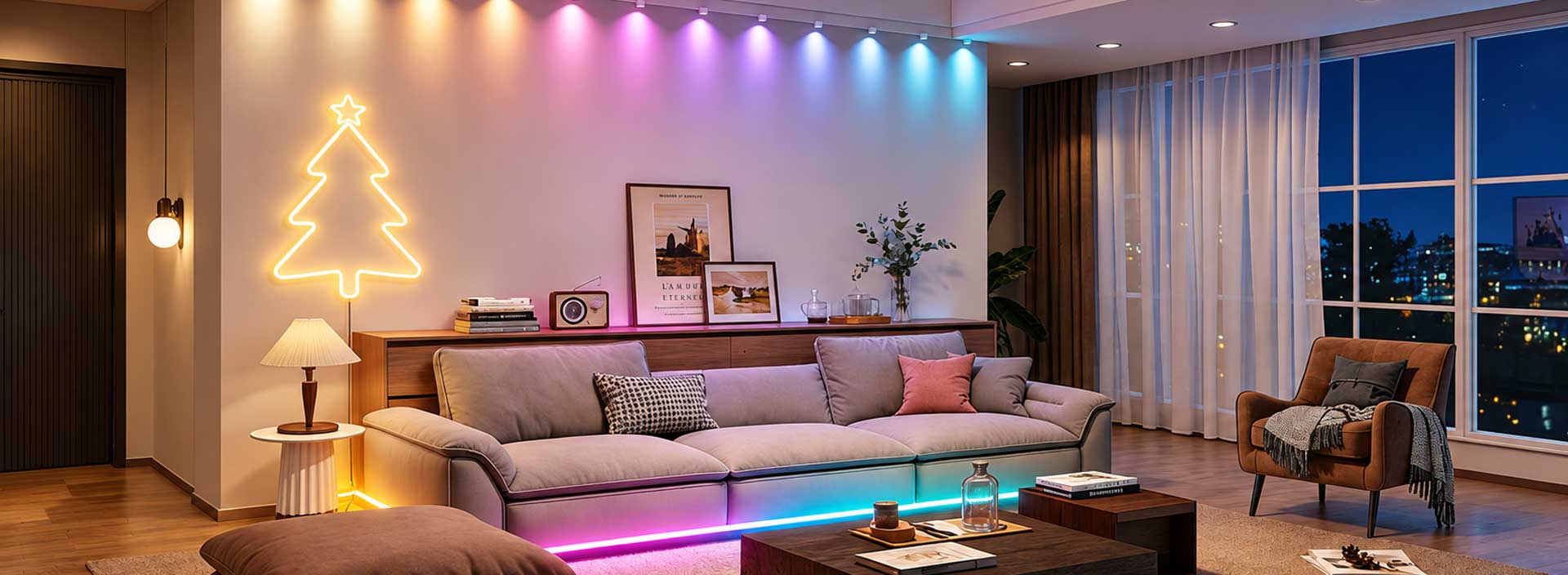
Smart Lighting devices selection for a project should be based on the space, lighting purpose, device quantity, control hierarchy, communication method, installation conditions, compatibility, maintenance, and future expansion. Individual product features matter, but every device must also operate consistently within the planned control system.
| Project Requirement | Device Selection Question | System Impact |
|---|---|---|
| Space type | Home, office, retail, or entertainment? | Determines lighting functions |
| Lighting task | Functional, decorative, or ambient? | Influences output and color control |
| Device quantity | How many units and zones are needed? | Affects network and group design |
| Control method | App, schedule, sensor, or voice? | Defines controller requirements |
| Installation | Indoor, outdoor, fixed, or flexible? | Affects structure and protection |
| Integration | Which platforms must connect? | Determines compatibility |
| Expansion | Will more devices be added later? | Requires scalable profiles |
This comparison helps buyers choose smart lighting devices for projects based on operating needs rather than selecting models independently.
Functional lighting prioritizes usable illumination, dependable dimming, consistent color temperature, and predictable schedules. Decorative and entertainment products may emphasize RGB colors, RGBIC effects, music synchronization, or dynamic scenes.
A project can contain both types, but they may not need identical controls. The system should identify which commands are shared and which remain product-specific.
For example, a general room group may support on/off and brightness, while a separate entertainment scene controls segmented colors and animation speed.
A project lighting system solution should define how devices connect, how commands are routed, and who has permission to control each area.
Small residential systems may organize lights by room and household account. Commercial installations may require buildings, floors, zones, operators, and administrators. The application and platform should make this hierarchy clear.
Buyers also need to determine whether control must continue locally during network interruption and which services depend on cloud access. These decisions influence communication modules, controllers, and platform configuration.
Compatibility should not be evaluated only by checking whether a product can appear inside the same application. Buyers must confirm which commands, scenes, automation rules, and third-party services actually work.
Verification should cover:
Pairing and device identification
Brightness and color controls
Group and zone operation
Schedules and automation
Multi-device synchronization
Voice commands by region and language
Firmware update support
Recovery after power or network loss
Testing production-equivalent units together provides more useful evidence than viewing a single demonstration sample.
Device construction must reflect the physical environment. Indoor products, outdoor lighting, flexible strips, permanent fixtures, and portable scene products have different installation and power requirements.
Cable length, connectors, controller placement, heat management, power access, mounting, and serviceability should be reviewed before the order is finalized. An attractive lighting product may still be unsuitable when maintenance access or installation space is limited.
The iot lighting hardware supplier should receive drawings, zone quantities, operating scenarios, and control expectations so the technical configuration can be checked against the project.
Project quality depends on how efficiently devices can be identified, assigned, tested, and replaced. Model names, device identities, firmware versions, and zone records should be managed systematically.
Installation teams need clear instructions for pairing, grouping, naming, and fault diagnosis. Replacement units should be capable of joining the established system without rebuilding unrelated zones.
Remote diagnostics and firmware management can also reduce maintenance effort, provided that permissions and update procedures are controlled properly.
The best smart lighting devices for projects are those that meet the required lighting task while remaining compatible with the complete control architecture. A pilot zone can verify installation, connection, scene timing, automation, permissions, and recovery before the full quantity is deployed.
Factory preparation should confirm hardware configuration, firmware, device profiles, accessories, labels, and packaging according to the approved project schedule. Component substitutions require technical review because they may affect control performance.
Successful device selection connects lighting output with system behavior, installation reality, and long-term service. Evaluating these factors together gives a project a more dependable path from sample approval to commissioning and future expansion.