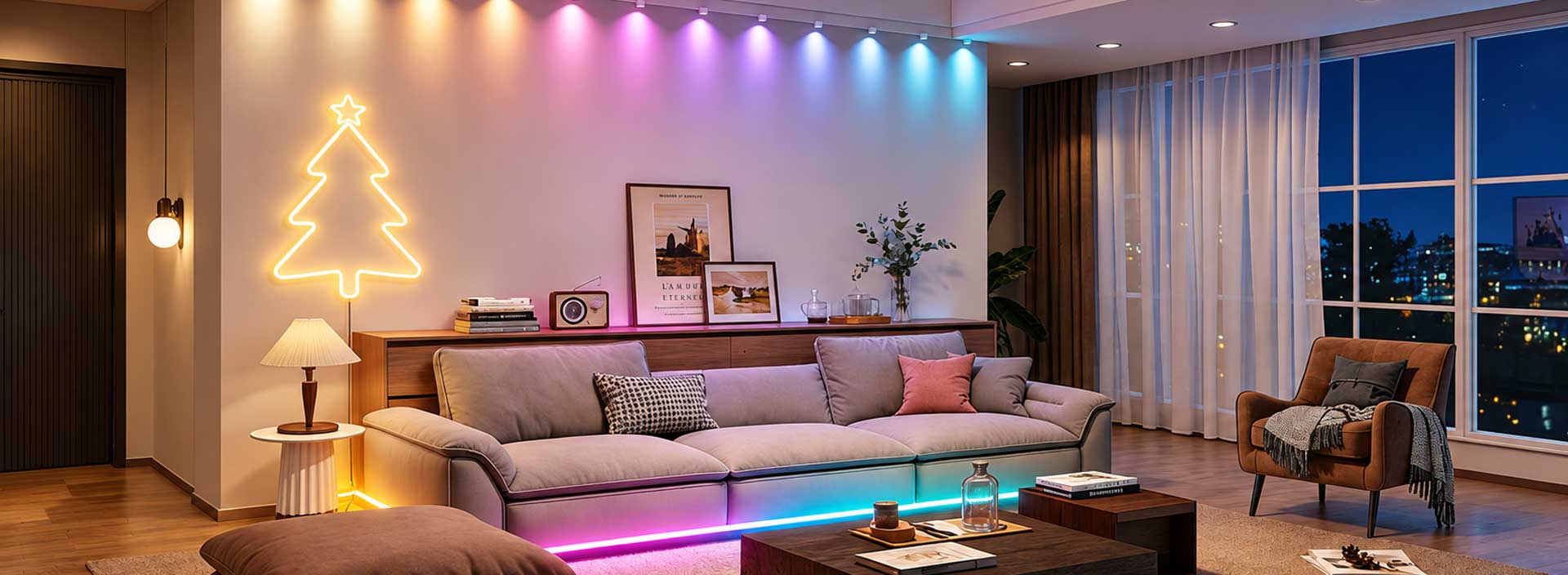
A smart home lighting system is a connected group of lights, controllers, applications, and platform services that allows users to manage illumination through mobile devices, automation, schedules, scenes, sensors, or voice commands. It can coordinate multiple rooms and products rather than controlling each fixture through a separate physical switch.
When a user sends a command, the application or control platform directs it to the appropriate lighting device. The product’s controller and firmware interpret the instruction and adjust power, brightness, color temperature, RGB color, or dynamic effects.
Depending on the architecture, communication may occur directly between a phone and device, through the local network, or through cloud services. Remote control, account management, and some automation functions generally require a connected platform.
This explains what is smart home lighting system in practical terms: it is not one intelligent bulb but an environment in which several lighting products can share controls and respond to coordinated rules.
| Function | Typical Household Use |
|---|---|
| Room grouping | Control several lights by location |
| Scene control | Prepare lighting for movies, work, or relaxation |
| Scheduling | Operate lights at defined times |
| Automation | Trigger lighting from time, status, or other conditions |
| Remote access | Check or control lights away from home |
| Voice control | Execute supported commands hands-free |
| Device sharing | Give household members authorized access |
| Firmware updates | Improve supported devices after installation |
A connected lighting control solution should make these functions easy to discover. Excessive menus or unclear device names can make a technically capable system difficult to use.
The system may combine bulbs, strips, ceiling fixtures, light bars, decorative lights, outdoor products, entertainment lighting, or compatible Electrical Accessories. Different products do not always share every command.
For example, a tunable-white fixture may support brightness and color temperature, while an RGBIC strip may offer segmented colors and flowing effects. Group controls need to recognize these differences and present only commands that all selected devices can perform consistently.
Device profiles, firmware, and application pages must therefore remain aligned as new categories are added.
Scenes let several products change together through one command. A movie scene may dim ceiling fixtures and activate ambient strips, while a bedtime scene may gradually reduce brightness across selected rooms.
Automation removes repeated manual control. Lighting may follow sunset, household schedules, sensor status, or actions from another connected device. Users should still be able to override an automation and understand why a light activated.
Effective automation relies on accurate device status, stable communication, and clearly defined conditions. Complicated rules without understandable feedback can increase support requests.
The iot home lighting system depends on communication among hardware, controllers, applications, routers, cloud services, and external platforms. A fault in any layer may appear to users as a lighting failure.
Evaluation should include first pairing, normal commands, reconnection, router changes, power recovery, remote operation, and multi-device timing. Voice access should be tested using the intended platform, language, region, and supported commands.
Security also matters. Account protection, authorization, data handling, and update management must be considered during platform development rather than added after products enter the market.
A smart home lighting control system must be evaluated on production-equivalent units. Engineering samples alone cannot confirm that firmware, communication modules, device identities, and assembly processes will remain consistent during mass production.
Factory testing should cover:
Correct controller and firmware configuration
Successful device identification and pairing
Response to all advertised commands
Color, dimming, and scene performance
Reconnection after power interruption
Accessories, labels, and packaging accuracy
Instructions that match the current application
Several units should be connected together to reveal grouping or synchronization problems that one product cannot show.
A scalable platform should allow new lighting categories to join existing accounts, rooms, and scenes without creating an entirely separate user experience. Backward compatibility is important because earlier products should retain core functions when the application evolves.
Hardware versions, firmware releases, application profiles, and production batches need traceable records. This makes updates more controlled and helps technical teams identify the source of field issues.
Smart home lighting creates lasting value when convenience, automation, compatibility, and manufacturing consistency work together. A coordinated system gives users a simpler way to manage different lighting activities while providing a practical foundation for expanding the product range.