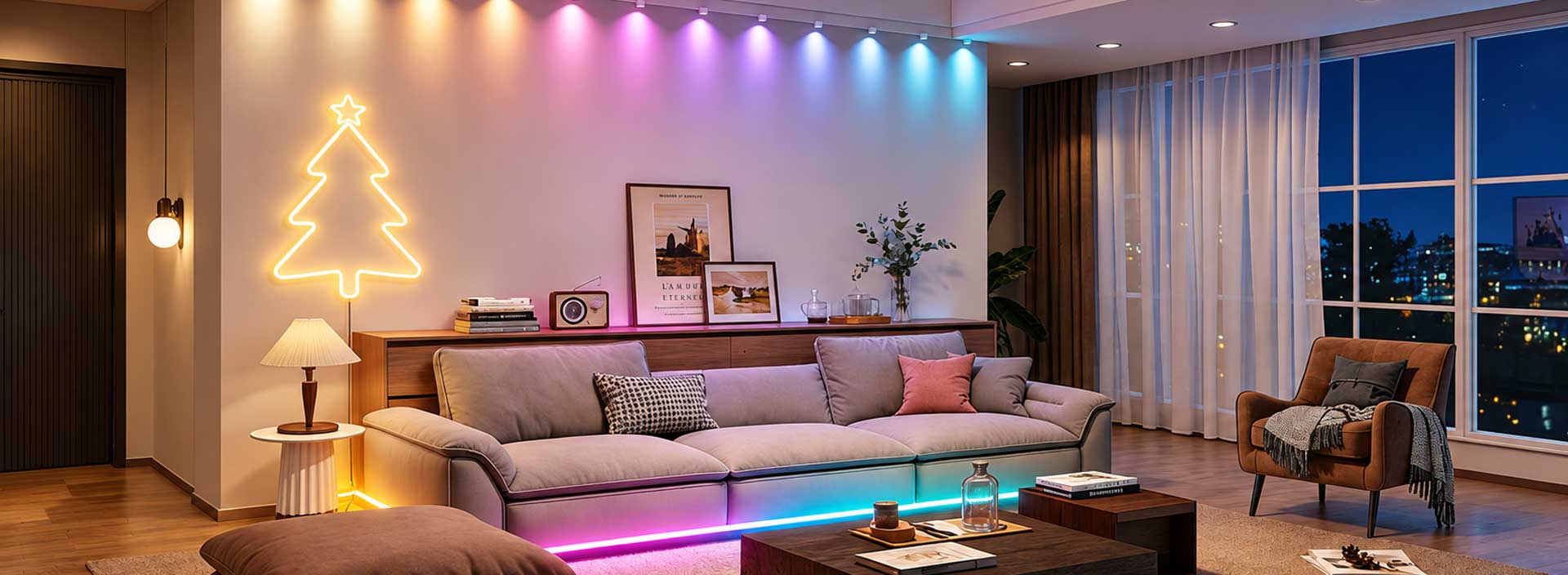
Smart Lighting system quality should be evaluated across hardware safety, lighting output, control response, connectivity, firmware, application usability, automation, compatibility, update reliability, and production consistency. A single functional sample cannot represent complete system quality; testing must cover normal operation, interruptions, recovery, multiple devices, and production-equivalent units.
The following smart lighting system quality checklist separates the product into measurable areas:
| Quality Area | Key Evaluation Items | Typical Test Condition |
|---|---|---|
| Hardware | Assembly, temperature, connectors, power | Extended operation |
| Lighting | Brightness, color, dimming, effects | Repeated adjustments |
| Connection | Pairing, range, reconnection | Different network states |
| Control | Response time and command accuracy | Local and remote operation |
| Synchronization | Timing across grouped devices | Multi-unit scenes |
| Firmware | Stability, updates, recovery | Normal and interrupted updates |
| Application | Setup, navigation, error guidance | New-user operation |
| Compatibility | Voice and external platforms | Verified commands |
| Production | Batch variation and configuration | Pilot-run sampling |
Results should be recorded against an approved specification rather than judged only through visual observation.
Electronic performance remains the foundation of a connected product. Housing fit, connectors, power components, controller installation, heat management, LED consistency, and accessory quality must be checked before software performance is evaluated.
Lighting tests should review output stability, dimming range, color consistency, transitions, dynamic effects, and extended operation. Products with segmented control need additional checks for effect direction, segment response, speed, and consistency across the complete illuminated area.
Testing should also include repeated power cycling. The product must return to the defined state and reconnect according to the intended operating logic.
lighting control performance testing should examine whether commands are executed correctly, consistently, and within an acceptable response time.
Evaluation should cover:
On/off and brightness adjustments
Color and color-temperature control
Scene activation and cancellation
Timers, schedules, and countdowns
Group and room control
Music or visual synchronization
Account sharing and permissions
Remote control outside the local network
Reconnection after temporary signal loss
Several identical units should be tested together. A system may perform well with one light but show delay, partial response, or inconsistent colors after a larger group is created.
Pairing quality affects first impressions and return rates. Evaluation begins when the package is opened and continues until the product is operating inside the intended app and external ecosystem.
Testers should follow the published instructions rather than internal engineering shortcuts. Pairing should be repeated with different supported mobile systems, account states, router conditions, and app versions.
Network interruption is equally important. The test should confirm what happens when Wi-Fi becomes unavailable, the router restarts, the application is closed, the account changes, or the device loses power.
Firmware controls local device logic and forms the bridge between hardware and application commands. Version management should identify which firmware belongs to each hardware configuration and production batch.
Update testing needs to verify installation, progress reporting, post-update functions, interrupted transmission, and recovery. An update system without a defined recovery route can create greater risk than the issue it was intended to correct.
Device logs and version records improve fault analysis and help prevent incompatible releases from reaching the wrong product group.
IoT lighting system standards may involve electrical safety, electromagnetic compatibility, wireless communication, cybersecurity, privacy, environmental requirements, and market-specific certification. The applicable set depends on the product structure, communication technology, and destination market.
Certification should be considered while components and electronics are being selected. Late identification of regional requirements can cause redesign, repeated testing, or packaging changes.
Compatibility claims also need documented verification. Listing a platform is not sufficient when only some commands, regions, or languages are supported.
To evaluate smart lighting system quality accurately, testing must progress from prototype to pilot production. Pilot units reveal assembly variation, component consistency, firmware-programming errors, labeling issues, and differences between engineering samples and factory processes.
Approved specifications should connect the bill of materials, firmware, app functions, accessories, packaging claims, and inspection criteria. Any component substitution requires an assessment of its effect on lighting performance and connectivity.
System quality is demonstrated through repeatable operation across products and batches. Coordinated testing of hardware, control, platform behavior, recovery, and manufacturing provides a stronger basis for approving a smart lighting product for release.