
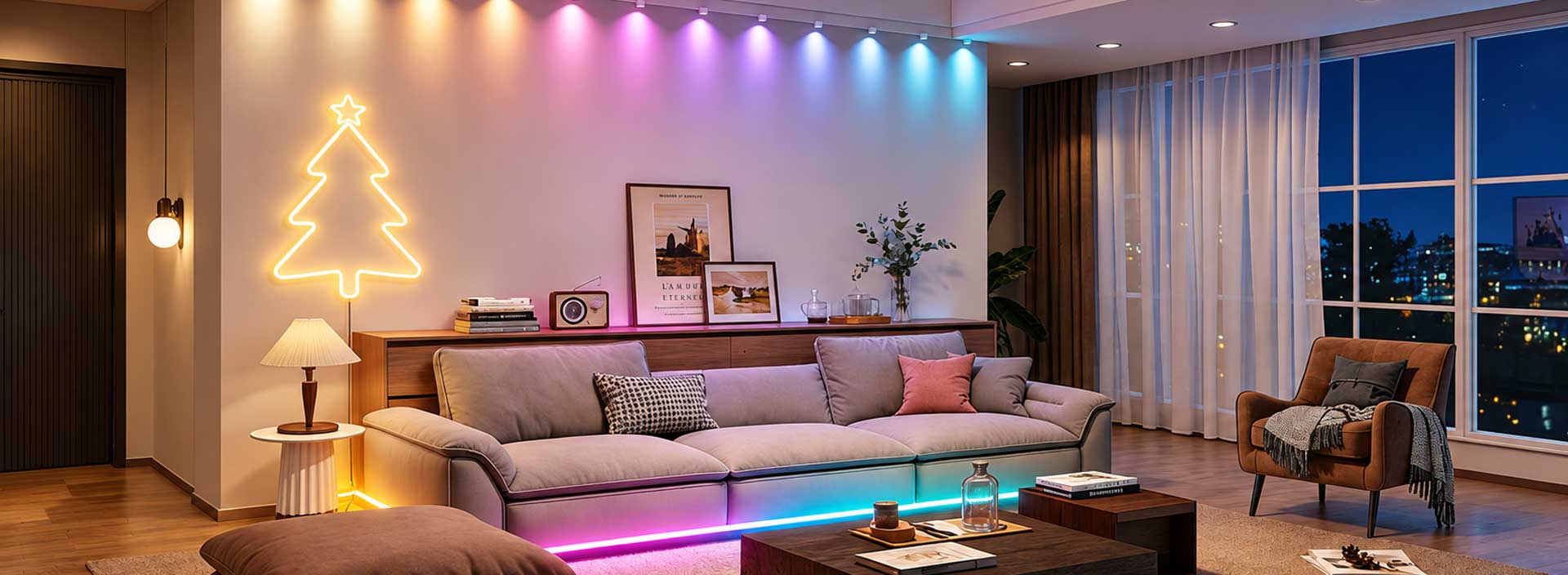
A Smart Lighting system is an intelligent lighting solution that connects lighting equipment with control technologies, sensors, and digital platforms to create a more adaptive lighting environment. Unlike traditional lighting that mainly depends on manual switches or fixed schedules, smart lighting can collect information, analyze conditions, and automatically adjust operation based on actual requirements.
The development of smart lighting has changed the role of lighting in modern spaces. Lighting is no longer only used to provide visibility but has become part of building automation, energy management, and user experience improvement. From offices and commercial buildings to industrial facilities, smart lighting systems provide a more flexible way to manage large and complex lighting environments.
The working principle of smart lighting is based on communication between different system components. Lighting devices, sensors, controllers, and management software form a connected network where information can be collected and processed.
When environmental conditions change, the system can respond automatically. For example, sensors can detect whether a space is occupied, while daylight sensors can measure natural brightness. Based on this information, the control system can adjust lighting output according to preset rules.
The basic operating process can be understood as:
Data Collection → System Analysis → Control Decision → Lighting Adjustment
This process allows lighting systems to operate more efficiently because adjustments are made according to real conditions rather than fixed settings.
A complete smart lighting system is not only composed of lighting fixtures. It combines multiple technologies that work together to achieve intelligent control.
The main components include:
Smart lighting fixtures that provide adjustable illumination
Sensors that collect information from the environment
Controllers that process commands and manage devices
Software platforms that allow monitoring and configuration
Each component has an important role. Without proper communication between these elements, the system cannot achieve reliable automation.
The biggest difference between traditional and smart lighting is the level of control and adaptability.
Traditional lighting usually follows simple commands. A switch turns lights on or off, and timers operate according to predefined schedules. However, these methods cannot easily respond to changing conditions.
A smart lighting system introduces automation and connectivity. It can manage multiple lighting areas, create customized scenes, and adjust operation according to occupancy, time, or environmental changes.
| Traditional Lighting | Smart Lighting System |
|---|---|
| Manual switching | Automated control |
| Fixed operation schedule | Dynamic adjustment |
| Independent lighting areas | Connected management |
| Limited monitoring | Real-time system information |
This difference makes smart lighting more suitable for modern buildings where efficiency and flexibility are important.
Smart lighting can be applied in many environments because the system structure can be adjusted according to different requirements.
In offices, smart lighting helps create comfortable working environments by controlling work areas, meeting rooms, and public spaces separately. In retail stores, lighting scenes can support different product displays and customer experiences.
Hotels, schools, factories, and public buildings also benefit from intelligent lighting because these environments often require centralized management across multiple areas.
Commercial buildings usually contain large lighting networks that require frequent management. When hundreds of lighting points operate independently, maintenance and energy control become more difficult.
A commercial smart lighting supplier typically focuses on solutions that improve centralized control, automation capability, and system scalability.
For building operators, smart lighting provides several practical improvements. Managers can monitor lighting conditions, adjust settings remotely, and create operation strategies based on actual building usage.
Energy efficiency is one of the main reasons organizations upgrade lighting systems.
A smart system can reduce unnecessary lighting operation by using automation rules. For example, lights in unused areas can be reduced, while areas with sufficient daylight can automatically adjust brightness.
This approach does not mean reducing lighting quality. Instead, it helps ensure that energy is used only when and where it is needed.
Before implementing a smart lighting system, the application environment should be carefully evaluated.
Important factors include existing electrical conditions, required control functions, communication methods, number of lighting zones, and future expansion plans.
A well-designed system should balance intelligent features with practical operation. Too little flexibility may limit future upgrades, while excessive complexity may increase management difficulty.
Smart lighting is becoming an important part of connected building ecosystems. Future systems will continue to integrate with more sensors, automation platforms, and data management technologies.
As buildings require better energy control and more flexible operation, lighting will continue evolving from a basic facility function into an intelligent management tool.
Understanding the working principle and application value of smart lighting helps organizations make better decisions when planning modern lighting environments.
Previous: